Making a change to a drug's production process might seem like a simple operational upgrade, but in the eyes of regulators, it's a high-stakes gamble. If you swap a tablet press or tweak a chemical pathway without the right paperwork, you aren't just risking a fine-you're risking a full product recall or a cease-and-desist order. The core problem is that any shift in how a drug is made can subtly alter its identity, purity, or potency, potentially turning a life-saving medication into something unsafe. To prevent this, agencies like the FDA and EMA have built a strict system of notifications and approvals that manufacturers must follow to the letter.
The goal here isn't to stop innovation, but to ensure that manufacturing quality remains consistent from the first batch to the millionth. Whether you're replacing a worn-out piece of equipment or moving a process to a new building, you need to know exactly which "bucket" your change falls into. Getting this classification wrong is one of the fastest ways to land a warning letter.
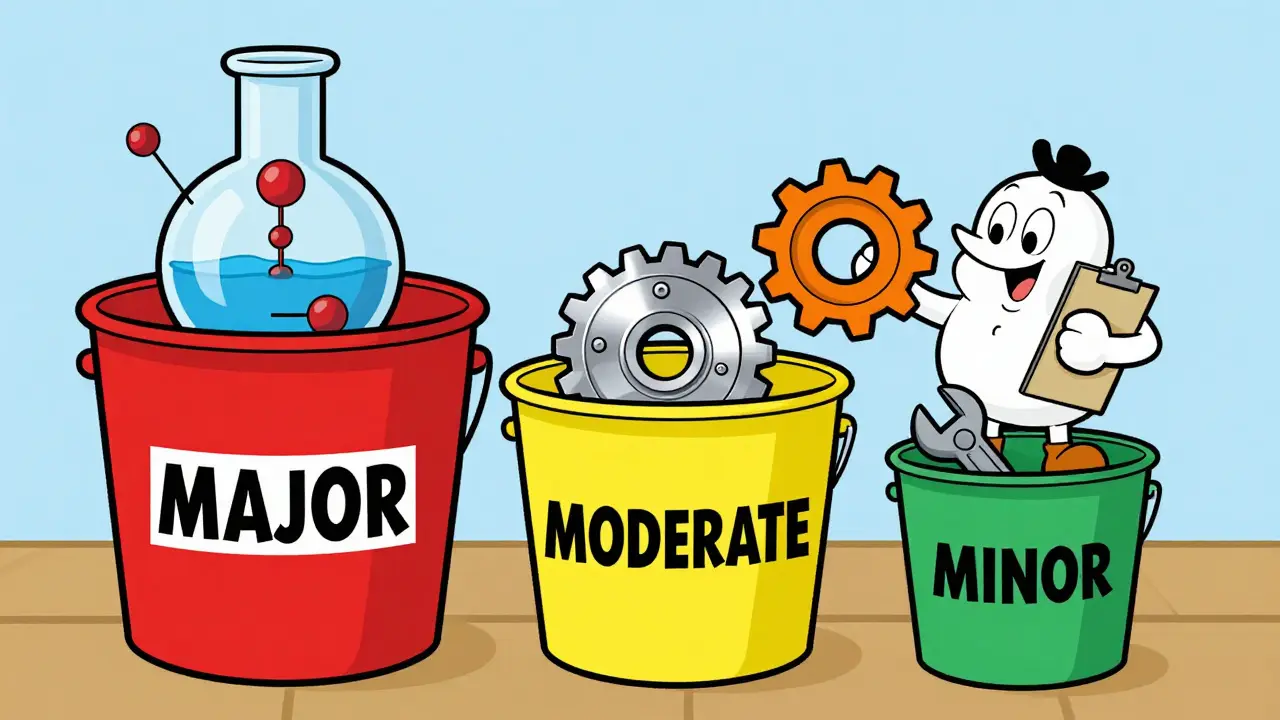
The Three Tiers of Change Classification
Regulatory bodies don't treat all changes the same. They use a risk-based approach: the more a change could possibly affect the final product, the more oversight it requires. In the U.S., the FDA is the federal agency responsible for protecting public health by ensuring the safety, efficacy, and security of human and veterinary drugs categorizes these under 21 CFR 314.70 for drugs and 21 CFR 601.12 for biologics.
Here is how the risk levels typically break down:
- Major Changes (Prior Approval Supplement - PAS): These are high-risk shifts. Think of changing the synthetic pathway for an active pharmaceutical ingredient (API) or adding a new manufacturing site for a critical step. You cannot distribute the product until the FDA explicitly approves the change.
- Moderate Changes (CBE-30 / CBE-0): These have a moderate potential to affect quality. A common example is replacing a piece of equipment with an equivalent model from the same manufacturer. A CBE-30 is a "Changes Being Effected in 30 Days" supplement, allowing the manufacturer to distribute the product 30 days after the agency receives the notice.
- Minor Changes (Annual Report): These are low-risk tweaks, like moving a non-critical step to a different room in the same facility. You don't need immediate approval; you just document it in your annual report within 60 days of your application anniversary.
Global Comparison: FDA vs. EMA vs. Health Canada
If you're selling globally, you can't just use one rulebook. While the logic is similar-risk equals more paperwork-the terminology and timelines differ. The European Medicines Agency is the agency responsible for the scientific evaluation, supervision, and safety monitoring of medicines in the EU uses a "Type" system, while Health Canada uses "Levels."
| Risk Level | FDA (USA) | EMA (EU) | Health Canada |
|---|---|---|---|
| High Risk | PAS (Prior Approval) | Type II Variation | Level I |
| Moderate Risk | CBE-30 / CBE-0 | Type IB Variation | Level II |
| Low Risk | Annual Report | Type IA Variation | Level III |
One major difference is the "do-and-tell" approach. The EMA's Type IA allows for implementation before notification for very minor changes, a flexibility that the FDA's system doesn't mirror as directly. On the other hand, the World Health Organization (WHO) Prequalification program is even more rigorous, often requiring a formal Comparability Protocol with detailed stability data before any equipment change is accepted.
When Is Equipment Truly "Equivalent"?
One of the biggest headaches for regulatory teams is deciding if a new piece of machinery is an "equivalent replacement" (CBE-30) or "new equipment" (PAS). This isn't just a semantic argument; it's a legal one. According to 2022 FDA guidance, for a machine to be considered equivalent, it must meet three specific criteria:
- Same principle of operation: If you're moving from a batch mixer to a continuous flow system, that's not equivalent.
- Same critical dimensions: The physical scale and geometry must be consistent enough that it doesn't change the fluid dynamics or heat distribution of the process.
- Same material of construction: Swapping stainless steel for a different alloy might introduce leachables or change how the product reacts, which could trigger a PAS requirement.
If you can't prove these three points, you're in PAS territory. A real-world example of this failure was seen in 2023, when Lupin Pharmaceuticals received a warning letter for replacing a lyophilizer (freeze-dryer) without a PAS. The agency viewed the replacement as a major change because of the sensitivity of the biologics involved.
The Role of Risk Assessment and FMEA
You can't just guess the risk level; you need a paper trail to justify it. Experts recommend using FMEA is Failure Modes and Effects Analysis, a systematic method for identifying all possible failures in a design or process. By scoring the severity, occurrence, and detection of a potential failure, you can provide a quantitative reason for your classification.
For instance, if you're changing a tablet press, your FMEA might look at how the change affects CQAs is Critical Quality Attributes, the physical, chemical, or biological properties that must be within an appropriate limit to ensure product quality. If the API particle size is highly sensitive, a change in the press could lead to uneven dosing. If your data shows the change has zero impact on these attributes, you have a strong case for a CBE-30. If the data is ambiguous, you're looking at a PAS.
Many large companies, like Pfizer, don't stop at FMEA. They use internal risk-scoring tools-sometimes involving 15 or more variables-to ensure that by the time a change reaches the regulatory agency, it has been vetted through multiple internal layers of quality assurance.
Navigating the Documentation Maze
Once you've classified the change, the paperwork begins. A common mistake is thinking that a "notification" is just a letter saying "we changed the machine." In reality, the FDA often requires a comprehensive supplement. For a manufacturing site change, you should be prepared to provide:
- Detailed facility diagrams showing the new layout.
- Process validation reports proving the new setup works as intended.
- Comparative batch data from at least three consecutive batches to show the product hasn't changed.
- Stability data demonstrating that the change didn't shorten the drug's shelf life.
The learning curve here is steep. Data suggests that regulatory specialists often need about 18 months of targeted training before they can consistently classify these changes without errors. This is why cross-functional teams-combining quality assurance, validation engineers, and regulatory experts-are essential. A single misstep in classification can delay a product launch by months or lead to a costly product recall.

The Future: ICH Q12 and Continuous Manufacturing
The industry is moving toward a more harmonized approach. The ICH Q12 is an International Council for Harmonisation guideline providing a framework for the lifecycle management of pharmaceutical products guideline aims to standardize how changes are managed globally. The goal is to move away from rigid "buckets" and toward a more flexible, established-knowledge-based system.
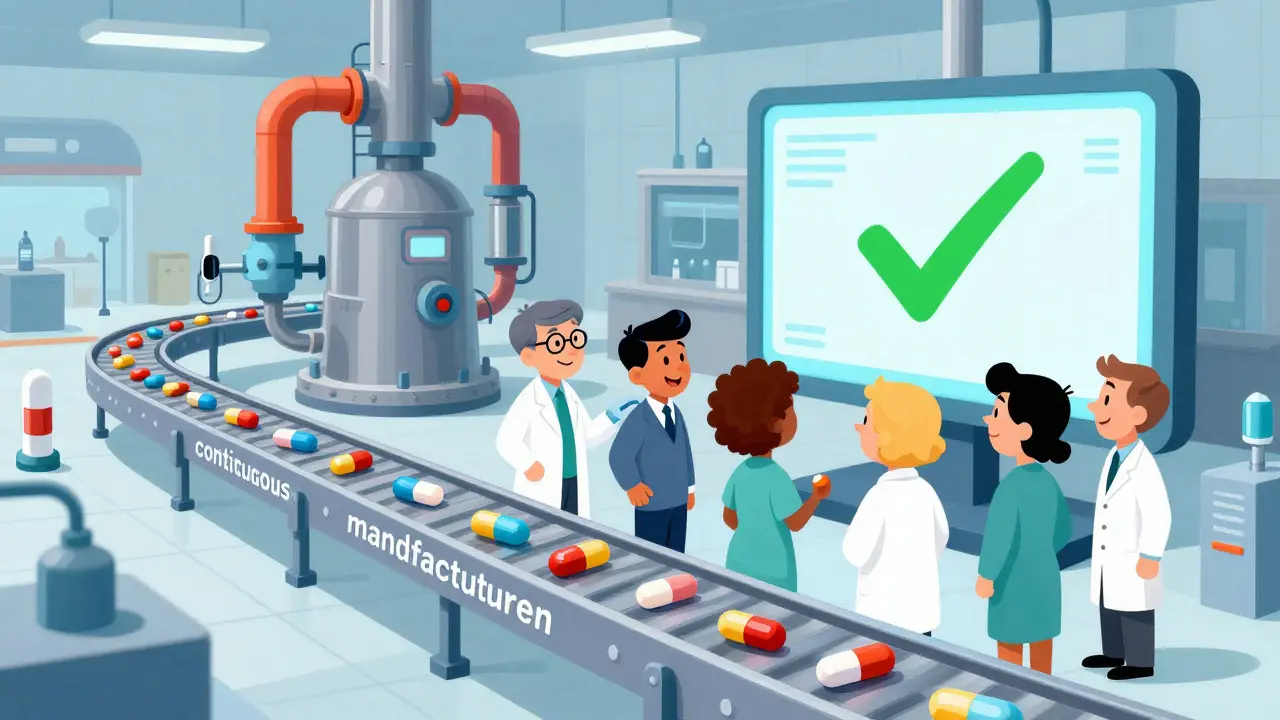
We're also seeing a shift toward continuous manufacturing. Unlike traditional batch processing, continuous systems are highly interconnected. If you change one sensor or pump in a continuous line, it can affect every subsequent step. Consequently, the FDA has noted that equipment changes in continuous systems are more likely to require PAS submissions because the risk of a "ripple effect" is much higher.
Looking ahead, real-time quality monitoring is the next frontier. By 2025, it's predicted that many companies will use real-time data to support their changes, potentially reducing the need for long waiting periods for approvals if the data proves the quality is constant in real-time.
What happens if I misclassify a major change as a moderate one?
You risk severe regulatory action. This typically starts with an FDA Warning Letter, but can escalate to a product recall or an order to stop distributing the drug. Because the product was distributed without the necessary Prior Approval Supplement (PAS), the agency may consider the product "adulterated" under the law.
How long is the waiting period for a CBE-30 change?
A CBE-30 (Changes Being Effected in 30 days) allows you to implement and distribute the changed product 30 calendar days after the FDA receives your submission. If the FDA objects within that window, they will notify you, and you must stop distribution.
Do I need a PAS for every new piece of equipment?
Not necessarily. If the equipment is a like-for-like replacement (same principle, same dimensions, same materials), it may qualify as a CBE-30. However, if the new equipment introduces a new technology or changes a Critical Process Parameter (CPP), a PAS is required.
What is the difference between Type IA and Type IB variations in the EU?
Type IA changes are minor and can often be implemented immediately with notification sent later (do-and-tell). Type IB changes are moderate and require the EMA's approval before the change can be implemented, though they are processed faster than the major Type II variations.
Can I combine multiple minor changes into one annual report?
Yes, minor changes that do not require prior approval or 30-day notifications are typically aggregated and submitted as part of the annual report. However, you must still maintain internal documentation and a risk assessment for each change in the meantime.
Next Steps for Compliance
If you're managing a change right now, your first move should be a gap analysis. Compare your current equipment specifications against the "equivalence" criteria (operation, dimensions, material). If there's any ambiguity, don't guess. The 2021 FDA guidance for biologics explicitly suggests early consultation with the agency.
For those in mid-sized firms with fewer resources, focus on building a robust FMEA library. Having a standardized way to justify why a change is "minor" or "moderate" will save you dozens of hours of cross-functional debating and provide a defensive shield during an audit. If you're moving toward ATMPs (Advanced Therapy Medicinal Products), be prepared for almost every change to be a PAS, as the sensitivity of these products leaves very little room for "moderate" classifications.