
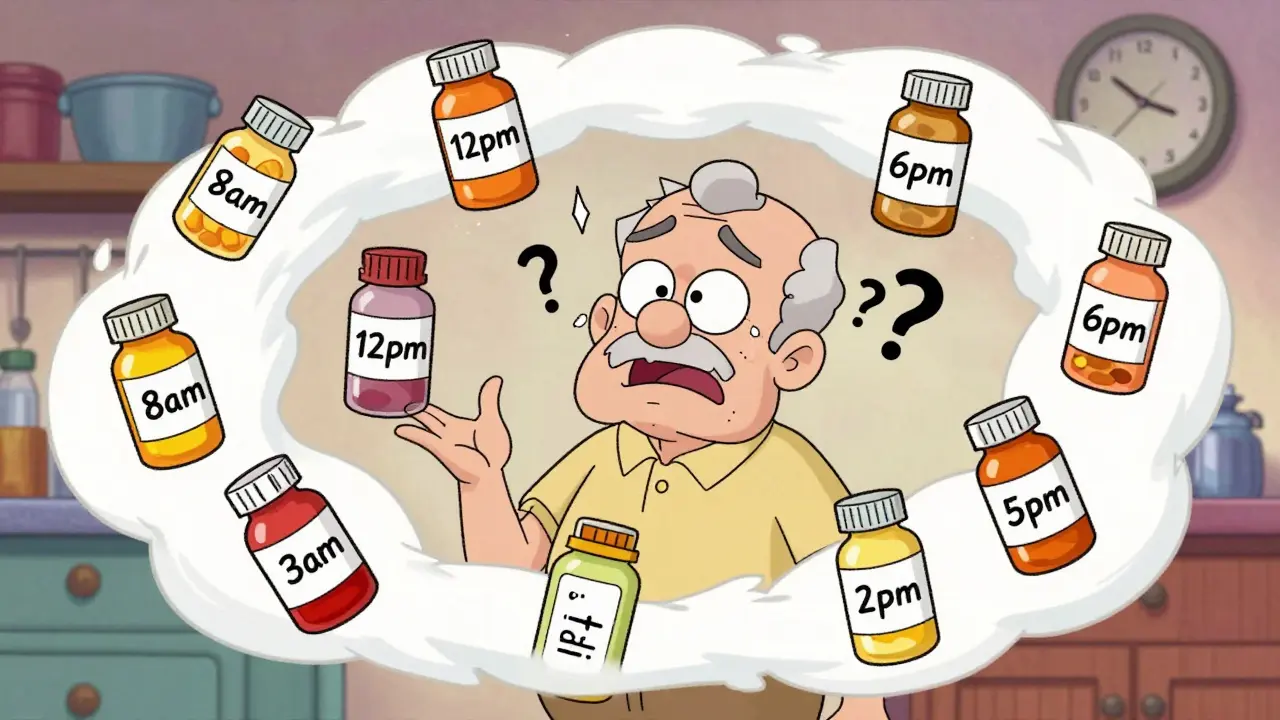
Imagine taking 12 pills a day-some in the morning, some after lunch, others at bedtime, and a few scattered between. Now imagine doing that every single day for months, maybe years. For many older adults and people managing multiple chronic conditions, this isn’t imagination-it’s reality. And it’s breaking them. Not because they’re forgetful or careless, but because the system is overwhelming. The good news? You don’t have to take that many pills every day. There are proven ways to cut down the number of daily doses without losing effectiveness. And it’s not just about convenience-it’s about staying alive, healthy, and in control.
Why Fewer Doses Matter More Than You Think
It’s not just about fewer pills. It’s about fewer decisions. Every time you open a pill bottle, you’re making a choice: Did I take this already? Is this the right one? Should I take it now or wait? That mental load adds up. Studies show that people who take four or more medications daily are twice as likely to miss doses compared to those on simpler regimens. And it’s not just older adults-people with diabetes, heart disease, HIV, or depression often juggle five, six, even ten different drugs. The result? Hospital visits go up. Complications grow. Costs climb.
The data is clear: when you reduce daily doses, adherence improves. One study found that switching from three doses a day to one dose a day for heart patients led to a 30% increase in people taking their meds correctly. Another showed that HIV patients on once-daily regimens missed only 4% of doses-down from 12% on multi-dose schedules. That’s not a small win. That’s life-changing.
Four Proven Ways to Cut Down Daily Doses
There’s no single fix. But there are four well-tested methods that work across different conditions and settings. Each has strengths, limits, and real-world trade-offs.
1. Fixed-Dose Combinations (FDCs)
This is where two or more drugs are combined into one pill. Think of it like a multivitamin for your chronic condition. For example, instead of taking separate pills for high blood pressure and cholesterol, you might get one pill that does both. About one-third of all simplification efforts use this approach.
It works best when the drugs have matching dosing schedules and don’t interfere with each other. For HIV patients, FDCs are now standard-they’ve cut daily pill counts from 10+ down to one or two. But it’s not always possible. If one drug needs to be taken with food and the other on an empty stomach, combining them could reduce effectiveness. And not all combinations are available-some insurers won’t cover the newer, combined versions unless you’ve tried the originals first.
2. Once-Daily Dosing
Some medications come in extended-release versions that last 24 hours. That means you can switch from taking a pill three times a day to just once. This is common for antidepressants, blood pressure meds, and some diabetes drugs.
But here’s the catch: not every drug can be made into a once-daily version. Some have short half-lives-they break down too fast. For example, certain antibiotics or pain relievers need to stay at a steady level in your blood, so splitting doses is necessary. A 2018 study found that even when patients stuck to once-daily HIV meds, their health didn’t improve much beyond better adherence. That’s because the drug was already working well-it just wasn’t being taken consistently before.
The key? Talk to your doctor or pharmacist. Ask: Is there an extended-release version of this? Can we switch? Don’t assume it’s impossible.
3. Medication Synchronization
This one doesn’t change your pills-but it changes your routine. Instead of getting refills on different days every month, you align them all to one day. So if you take five medications, you pick one day-say, the first Tuesday of every month-and get all your refills then.
It cuts down on pharmacy trips by 60%. It also reduces the chance of running out of one drug while others are still stocked. And it makes it easier to spot gaps. If you forget to pick up your blood pressure med but remember your diabetes pill, you’ll notice the mismatch.
It requires coordination. Your pharmacist has to work with your doctors and insurance. Some plans don’t allow it. But if your pharmacy offers it, ask. It’s free, easy, and often overlooked.
4. Multi-Dose Compliance Packaging
This is the pill organizer you’ve probably seen in nursing homes. It’s a plastic tray with compartments for morning, noon, evening, and bedtime. Your pharmacist fills it for you each week or month.
Studies show it boosts adherence by 22% compared to loose pills. For someone with memory issues or visual impairments, it’s a game-changer. One caregiver on AgingCare.com said her mother went from confusion and missed doses to taking everything correctly-just because she could see the pills laid out in order.
The downside? Cost. It can add $15-$20 a month to your bill. And if you’re on Medicare Advantage or Medicaid, coverage varies. Some plans pay for it. Others don’t. Ask your pharmacist: Is this covered? Can you help me apply?
The Universal Medication Schedule: A Simple Framework
There’s a reason pharmacies use four time slots: morning, noon, evening, bedtime. It’s called the Universal Medication Schedule. It’s not magic-but it’s simple. Most people can remember four times a day. Seven? Not so much.
Research shows that nearly 30% of patients take their meds seven or more times daily. That’s a recipe for error. The goal? Get everyone down to four or fewer. You don’t need to change the drug-just the timing. For example, if you’re supposed to take a pill at 8 a.m., 2 p.m., and 8 p.m., that’s already three slots. Can you move the 2 p.m. dose to noon? Maybe. Can you combine it with another drug? Possibly.
Ask your pharmacist to map your current schedule onto the four-time framework. They’ll often find room to merge or shift doses without risk.

What You Need to Do Next
Don’t wait for your doctor to bring it up. Take charge.
- Write down every pill you take-including vitamins, supplements, and over-the-counter meds. Don’t trust your memory.
- Check the dosing times. Are you taking some meds twice a day when they could be once? Are any taken at odd hours like 3 a.m.?
- Bring this list to your pharmacist. Pharmacists are trained to spot simplification opportunities. They see hundreds of regimens every week.
- Ask these three questions:
- Can any of these be combined into one pill?
- Are there extended-release versions available?
- Can my refills be synced to one day a month?
- Request a medication review. If you’re on Medicare, you’re entitled to one annual medication therapy management session. Use it.
The Hidden Barriers (And How to Beat Them)
It sounds simple. But real life gets in the way.
Insurance denies the new pills. If your insurer won’t cover a once-daily version because it’s “more expensive,” ask for a prior authorization. Your doctor can write a letter explaining why the simpler regimen improves adherence. Many insurers approve these when backed by data.
You’re confused by the new schedule. A 2022 survey found that 68% of pharmacists say patients misunderstand simplified regimens. One woman thought she could crush her new combo pill because her old ones were crushed. That’s dangerous. Always ask: Can I break or open this? Should I take it with food?
Your doctor doesn’t know. Only 35% of primary care practices use formal simplification tools. If your doctor says no, ask to speak with the pharmacist or request a referral to a medication therapy management program.
Cost is too high. If multi-dose packaging costs too much, ask if your pharmacy offers a discount program. Some community pharmacies give it free to low-income patients. Others will mail it to you at no extra charge.

It’s Not About Less Medicine-It’s About Smarter Medicine
Simplifying your regimen doesn’t mean cutting corners. It means removing the noise. You still get the same treatment. You just get it in a way that fits your life.
One man in Canberra, 72, used to take 11 pills a day for diabetes, high blood pressure, and arthritis. After a pharmacist reviewed his list, they switched two drugs to once-daily versions, synced his refills, and moved his evening pain pill to bedtime. He went from 11 doses to 4. He stopped missing pills. He stopped feeling overwhelmed. And he started walking again.
You don’t need to be perfect. You just need to be consistent. And fewer doses make that possible.
Can I just stop taking some of my meds if I feel better?
No. Feeling better doesn’t mean the condition is gone. Many medications-like those for blood pressure, cholesterol, or diabetes-work best when taken daily, even if you feel fine. Stopping them suddenly can cause dangerous rebounds. Always talk to your pharmacist or doctor before making changes.
Are once-daily pills less effective than multiple doses?
No. Once-daily versions are designed to release medication slowly over 24 hours. They’re tested to deliver the same total dose as multiple smaller doses. In fact, because people take them more consistently, they often work better in real life-even if lab results look similar.
Can I use a pill organizer for all my medications?
Not always. Some pills shouldn’t be stored in organizers-like those sensitive to moisture, heat, or light. Others, like sublingual tablets or capsules that dissolve quickly, can stick together or lose potency. Always ask your pharmacist which meds are safe to put in a compartment organizer.
How do I know if my regimen can be simplified?
If you’re taking five or more medications daily, or if you’re taking any drug more than three times a day, there’s a good chance it can be simplified. The average older adult can reduce their daily doses by at least one or two. Ask your pharmacist to run a quick review-it takes less than 15 minutes.
Will simplifying my meds save me money?
Often, yes. Fewer pills mean fewer copays. Fixed-dose combinations can cost less than buying two separate drugs. Synchronizing refills reduces trips to the pharmacy, saving time and gas. And if you avoid hospital visits by sticking to your regimen, your long-term savings could be thousands.
What Comes Next?
If you’ve made it this far, you’re already ahead. You’re thinking about your health in a smarter way. Now, take action.
Write down your current list. Call your pharmacy. Ask for a medication review. Bring the list to your next doctor visit. Say: “I want to make this easier to manage. Can we simplify it?”
You don’t need to fix everything at once. Start with one change. Maybe it’s syncing your refills. Maybe it’s asking about a once-daily version of your blood pressure pill. Small steps add up.
Medication isn’t just about chemistry. It’s about human life. And when the system works for you-not against you-health becomes possible again.
Marc Bains
February 1, 2026 AT 10:26Let me tell you something real: this isn’t just about pills. It’s about dignity. I’ve seen my dad collapse from polypharmacy fatigue-14 meds, no rhythm, no clarity. He didn’t forget. He was exhausted. When we synced his refills and switched his BP med to extended-release, he started cooking again. Not because the drugs changed, but because his life stopped being a spreadsheet. This is healthcare that respects human capacity, not just clinical protocols.
Kelly Weinhold
February 1, 2026 AT 21:46YES. This. I work with seniors and I swear by pill organizers. One woman I helped went from 8 doses to 3 after we moved her evening antidepressant to bedtime and synced her refills. She cried when she realized she hadn’t missed a dose in 3 months. It’s not magic-it’s logistics. And pharmacies? They’re the unsung heroes here. Ask for a med review. They’ll do it for free. Seriously. Just ask.
Rob Webber
February 2, 2026 AT 08:46This post is a goddamn corporate PR piece wrapped in empathy. Everyone knows you can simplify regimens. The problem is insurance won’t pay for the combo pills, doctors are too lazy to coordinate, and pharmacies charge $20 to fill a plastic box. This isn’t about adherence-it’s about profit. The system wants you drowning so you keep buying more meds. Don’t fall for the feel-good fluff.
calanha nevin
February 2, 2026 AT 22:22Pharmacists are trained to identify therapeutic duplication and dosing inefficiencies. A 2021 JAMA study demonstrated that structured medication therapy management interventions reduced pill burden by an average of 2.7 daily doses among adults over 65 with three or more chronic conditions. The key is initiating proactive review-not waiting for crisis. Medicare Part D beneficiaries are entitled to one annual MTM session. Utilize it. Documentation and interprofessional communication are non-negotiable for sustainable outcomes.
Lisa McCluskey
February 3, 2026 AT 18:33I’ve used pill organizers for years. But I learned the hard way-some meds can’t go in them. My thyroid pill gets sticky if it’s near moisture. My doctor didn’t warn me. Always check with your pharmacist. And don’t assume the combo pill is better-sometimes the individual doses let you adjust more precisely. Just because it’s simpler doesn’t mean it’s right for you.
Russ Kelemen
February 4, 2026 AT 16:54There’s a deeper question here. Why do we treat medication like a checklist instead of a rhythm? We’re not machines. Our bodies don’t care about 8 a.m., 2 p.m., 8 p.m. They care about consistency. The real breakthrough isn’t the pill-it’s the peace. When you stop fighting your own routine, your body stops fighting you. I didn’t simplify my meds to be efficient. I did it to stop feeling like a prisoner to my own health.
April Allen
February 4, 2026 AT 23:02Fixed-dose combinations are pharmacoeconomically optimal but clinically nuanced. The pharmacokinetic profile must align-not just the dosing interval. For instance, combining a proton pump inhibitor with a thiazide diuretic may alter gastric pH and reduce bioavailability of the latter. Clinical decision support tools like Medscape’s MedCheck or Epic’s CDS alerts can flag incompatible combinations. Always verify with a clinical pharmacist before switching. The data supports simplification, but not at the cost of therapeutic integrity.
Amy Insalaco
February 6, 2026 AT 08:13Let’s be honest: this entire framework is a fantasy for anyone without a private insurance plan and a neurologist on speed dial. I take 9 meds. Two are combo pills. One is extended-release. Three require fasting. One must be taken with a full glass of water at 11 p.m. because of a 2007 FDA advisory that no one remembers. My pharmacy charges $18 for a weekly organizer. Medicare won’t cover it. My doctor says, ‘You’re doing fine.’ I’m not doing fine. I’m surviving. This post reads like a pharmaceutical ad written by someone who’s never had to open a bottle at 3 a.m. while shaking from hypoglycemia. Simplify this: stop pretending systemic neglect is a personal responsibility.
Diana Dougan
February 7, 2026 AT 23:46