
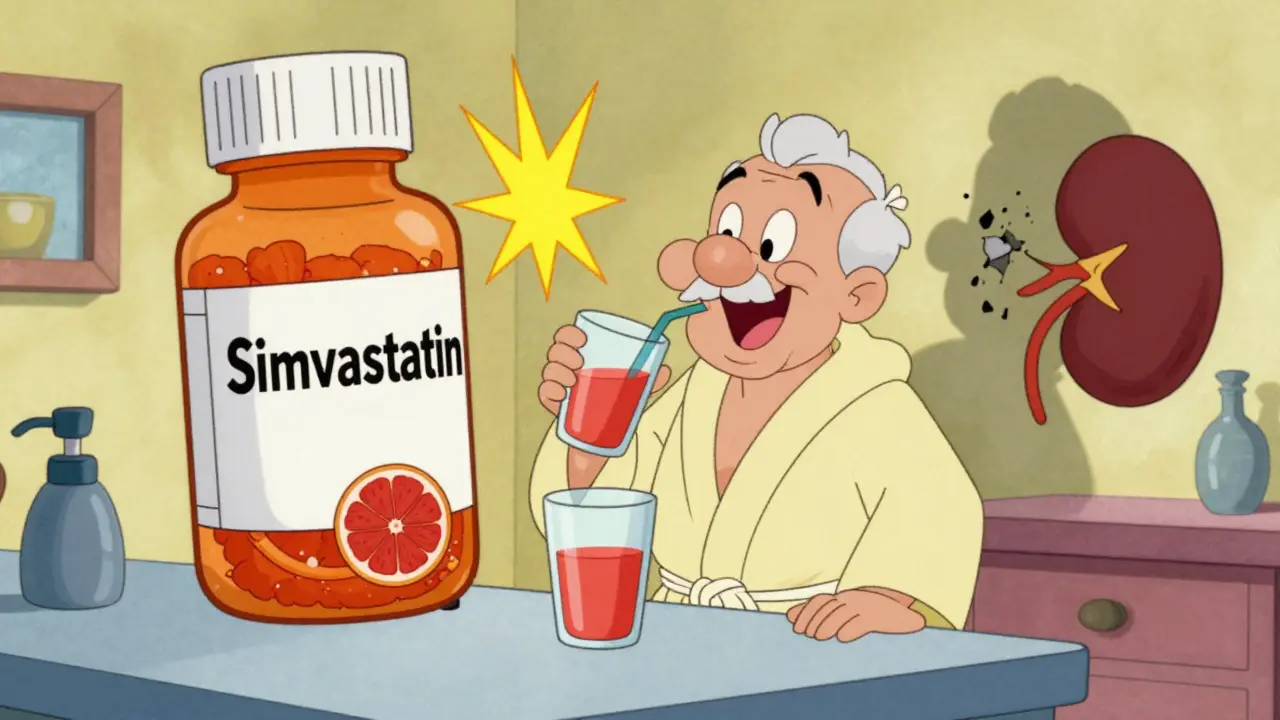
Drinking a glass of grapefruit juice in the morning might feel like a healthy habit-until it turns dangerous. For people taking certain medications, this citrus favorite can trigger serious, even life-threatening reactions. It’s not about allergies or sugar. It’s about how grapefruit juice interferes with how your body processes drugs. And the risk isn’t small. More than 85 prescription medications have documented interactions with grapefruit, and 43 of them can cause fatal side effects when mixed together.
Why Grapefruit Juice Changes How Your Medicines Work
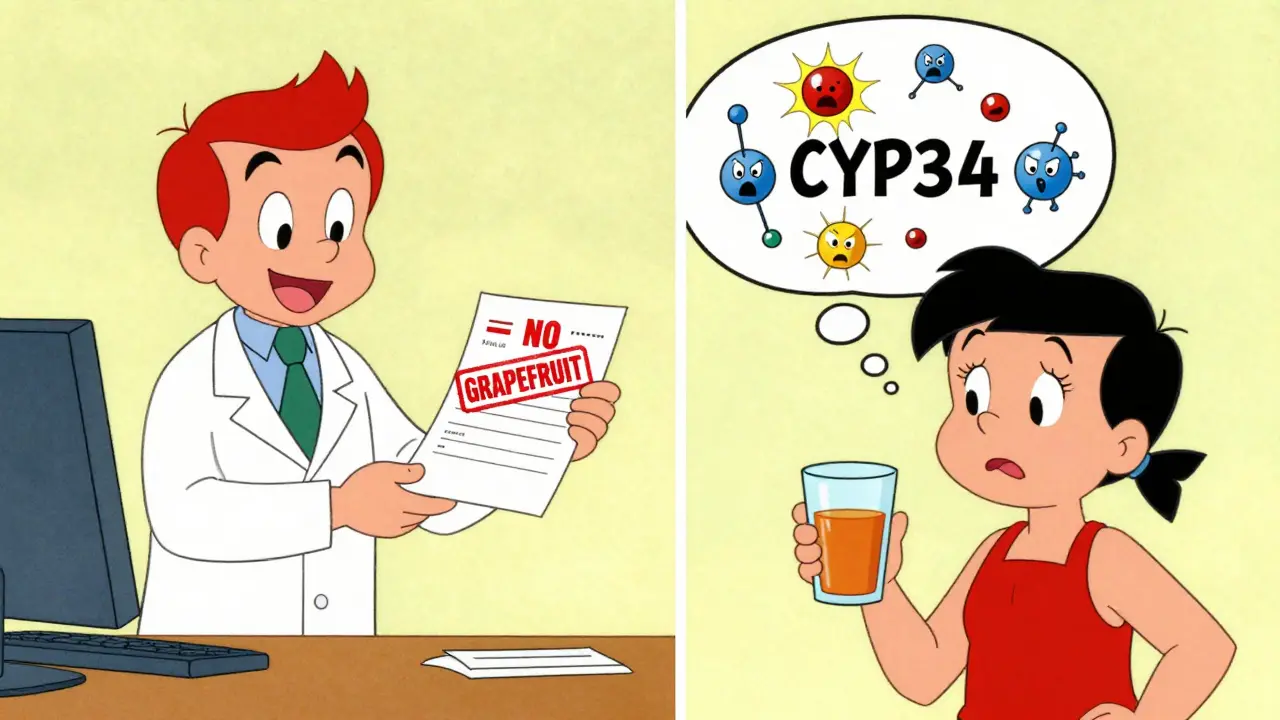
The problem starts in your gut. When you swallow a pill, your body uses an enzyme called CYP3A4 to break down many drugs before they enter your bloodstream. This enzyme acts like a gatekeeper-it limits how much of the drug gets absorbed. Grapefruit juice doesn’t just slow this process. It shuts it down. The juice contains chemicals called furanocoumarins, mainly bergamottin and 6',7'-dihydroxybergamottin. These compounds bind to CYP3A4 in your intestines and destroy it. Once that enzyme is gone, your body can’t break down the drug properly. That means more of it floods into your blood-and stays there longer than it should.
What’s scary is how fast this happens. Just one 200-milliliter glass (about 6.7 ounces) of fresh grapefruit juice can reduce CYP3A4 activity by nearly half within four hours. And it doesn’t wear off quickly. The enzyme takes 24 to 72 hours to regenerate. So even if you take your medication hours after drinking grapefruit juice, the damage is already done. That’s why experts say you can’t just space them out. You have to avoid grapefruit entirely while you’re on these drugs.
Which Medications Are Most at Risk?
Not all medications react the same way. But some are far more dangerous when mixed with grapefruit. Here are the biggest red flags:
- Statins (cholesterol drugs): Simvastatin (Zocor) is the most dangerous. Drinking grapefruit juice while on simvastatin can triple your drug levels. That raises your risk of rhabdomyolysis-a condition where muscle tissue breaks down, which can lead to kidney failure. Atorvastatin (Lipitor) has a milder interaction, but still risky. Pravastatin and rosuvastatin? Safe. No interaction. If you’re on simvastatin and love grapefruit, talk to your doctor about switching.
- Calcium channel blockers (blood pressure meds): Felodipine (Plendil) sees a five-fold increase in blood levels. Nifedipine (Procardia) jumps 3.3 times. Amlodipine (Norvasc)? Minimal effect. The difference matters. If your blood pressure drops too low because of this interaction, you could pass out, fall, or have a stroke.
- Immunosuppressants: Cyclosporine (Neoral), used after organ transplants, can spike 50-60% in concentration with grapefruit. That raises the risk of kidney damage and other toxic effects. For transplant patients, this isn’t just inconvenient-it’s life-threatening.
- Antiarrhythmics: Amiodarone (Cordarone), used for irregular heartbeats, increases by 30-40%. That can trigger dangerous heart rhythms.
On the flip side, some drugs show little to no interaction. Trazodone (for depression), zolpidem (Ambien for sleep), and certain antihistamines like fexofenadine (Allegra) are generally safe. But don’t assume. Always check with your doctor or pharmacist.
Not All Citrus Is the Same
Just because grapefruit is dangerous doesn’t mean all citrus is. Sweet oranges-like navel or Valencia-are safe. Lemons and limes? Also safe. But Seville oranges (the kind used in marmalade) and pomelos? They contain the same furanocoumarins as grapefruit. So if you’re on a risky medication, skip those too.
Even processing matters. Fresh-squeezed grapefruit juice has the highest concentration of furanocoumarins. Pasteurized juice? Less, but still enough to cause harm. And grapefruit extracts in supplements? Just as dangerous. The interaction isn’t about the fruit-it’s about the chemicals. So if a product says it contains grapefruit, avoid it.
Who’s Most at Risk?
Older adults are especially vulnerable. People over 65 make up 40% of grapefruit juice drinkers in the U.S., according to USDA data. They’re also more likely to be on five or more medications at once-many of them metabolized by CYP3A4. A 70-year-old on simvastatin, a blood pressure pill, and a heart rhythm drug who drinks grapefruit juice every morning? That’s a perfect storm.
Also, your body’s natural enzyme levels vary. Some people have more CYP3A4 in their intestines than others. That means one person might get a 2-fold increase in drug levels, while another gets an 8-fold spike after the same amount of juice. There’s no test to find out where you fall on that scale. So the only safe rule? Assume you’re in the high-risk group.
What Should You Do?
If you’re on medication, here’s what to do right now:
- Check your meds. Look at your prescription labels. If they warn against grapefruit, take it seriously. The FDA requires this warning on 76% of affected drugs.
- Ask your pharmacist. When you pick up a new prescription, ask: “Can I drink grapefruit juice with this?” Pharmacists are trained to catch these interactions. One study found 89% of community pharmacists routinely screen for them.
- Keep a medication list. Include everything: prescriptions, over-the-counter drugs, vitamins, herbal supplements. Some supplements, like St. John’s wort, also affect CYP3A4. Write it down. Bring it to every appointment.
- Ask about alternatives. If you’re on simvastatin, ask if pravastatin or rosuvastatin is an option. If you’re on cyclosporine, ask about tacrolimus. These alternatives work just as well without the grapefruit risk.
- Don’t guess. Even if you’ve been drinking grapefruit juice for years with no problems, that doesn’t mean it’s safe. The interaction can build up over time. Or your body’s enzyme levels might change. One bad reaction is all it takes.
What’s Being Done About It?
Regulators are catching up. Since 2017, the FDA has required drugmakers to test new oral medications with grapefruit juice during development. The European Medicines Agency now requires the same. That means future drugs will come with clearer warnings.
Science is also looking for solutions. In October 2023, the USDA announced that CRISPR-edited grapefruit with 90% less furanocoumarin had passed early safety trials. These aren’t on shelves yet-but they could change the game. Imagine a grapefruit you can safely enjoy with your meds. That’s the future.
But for now? The advice hasn’t changed. If your drug warns against grapefruit, avoid it completely. Not just at dosing time. Not just in the morning. All day, every day, for as long as you’re on the medication.
Why This Matters More Than You Think
This isn’t just about avoiding a fruit. It’s about understanding how your body works-and how easily it can be thrown off. Many people think drug interactions mean two pills clashing. But this is different. It’s a food changing how your body handles a drug. And it’s silent. You won’t feel it happening. No warning signs until it’s too late.
Statins alone cost the pharmaceutical industry $1.2 billion a year in lost sales because people quit taking them to avoid grapefruit. That’s not because they didn’t trust the medicine. It’s because they didn’t know the risk. And that’s the real problem: awareness is low. A 2022 survey found only 38% of patients recalled being warned about grapefruit when they got their prescription.
Don’t be one of them. Talk to your doctor. Ask your pharmacist. Read your labels. And if you love grapefruit juice? Find a safe alternative-like orange juice. Your body will thank you.

jigisha Patel
January 5, 2026 AT 19:16The pharmacokinetic implications of furanocoumarin-mediated CYP3A4 inhibition are profoundly underappreciated in primary care settings. The irreversible binding of bergamottin to the intestinal enzyme isoform creates a non-linear pharmacodynamic curve that cannot be mitigated by temporal separation of ingestion. The 24-72 hour recovery window is not a suggestion-it’s a biochemical imperative. Patients must be educated that even trace amounts in supplements or marmalade constitute a clinically significant exposure. This is not anecdotal; it’s evidenced by randomized controlled trials with AUC measurements exceeding 300% increases. The FDA’s post-2017 mandate is merely the baseline-pharmaceutical companies should be required to label all CYP3A4 substrates with the same urgency as black box warnings.
Jason Stafford
January 6, 2026 AT 04:27They don’t want you to know this-but grapefruit juice is a government-approved drug delivery system. The FDA knows full well that 85 medications are compromised by it. Why? Because Big Pharma needs you dependent. They don’t care if you live or die-they care if you keep buying pills. And now they’re pushing CRISPR grapefruit? That’s not innovation-that’s a Trojan horse. They’ll engineer a 'safe' grapefruit, then patent it, charge you $15 a glass, and make you think you’re being 'responsible'. Meanwhile, your liver’s still screaming. Wake up. This is control. They don’t want you to have real food. They want you hooked on their chemistry.
Justin Lowans
January 6, 2026 AT 16:59This is one of those rare public health messages that’s both simple and life-saving. I’ve seen patients on simvastatin who’ve been drinking grapefruit juice for a decade without incident-only to end up in the ER with rhabdomyolysis after a minor infection that altered their metabolism. The variability in CYP3A4 expression is staggering, and assuming safety based on past behavior is like driving without a seatbelt because you’ve never had an accident. I always tell my patients: if the label says 'avoid grapefruit', treat it like a red light. No exceptions. Orange juice is delicious, and it doesn’t try to kill you.
Michael Rudge
January 7, 2026 AT 11:11Oh, so now we’re supposed to feel guilty for enjoying a glass of citrus? How dare you tell me what I can and cannot consume? My body, my rules. And let’s be honest-how many people even know what CYP3A4 is? Probably fewer than those who can spell 'pharmaceutical'. You want to save lives? Start by making doctors actually read the damn labels before prescribing. Or better yet-ban all medications that can be 'ruined' by fruit. Maybe then we’ll stop treating patients like fragile lab rats instead of adults. I’ll drink my grapefruit juice. And I’ll die on my own terms.
Ethan Purser
January 8, 2026 AT 06:21It’s not about the juice. It’s about the system. We live in a world where your body’s natural enzymes are weaponized by corporate chemistry. Grapefruit juice is the canary in the coal mine-revealing how fragile our biological autonomy really is. We’re told to trust science, but then science lets a fruit-something ancient, natural, sacred-be demonized because it disrupts the profit model. The real tragedy isn’t the drug interaction. It’s that we’ve been conditioned to fear food, not pharmaceuticals. I used to love grapefruit. Now I see it as the last honest thing left in a world of synthetic lies. And I drink it defiantly. Every morning. As an act of resistance.
Doreen Pachificus
January 10, 2026 AT 03:21Interesting that they mention Seville oranges but don’t talk about pomelo hybrids. I’ve seen people drink grapefruit-pomelo blends thinking they’re 'healthier'-but the furanocoumarin levels are actually higher. Also, the USDA data on older adults drinking it-any idea how many are on statins? My grandma’s on Lipitor and drinks it daily. She says she’s 'never had a problem'. I’m not convinced that’s a good sign.
Cassie Tynan
January 10, 2026 AT 03:43Let’s be real-this isn’t about grapefruit. It’s about how we’ve outsourced our health to pills and then blamed the fruit when the pills misbehave. We’ve turned our bodies into machines that need perfect inputs, and when they don’t comply, we panic. But what if the problem isn’t the juice? What if it’s that we’re taking too many drugs that shouldn’t be taken at all? Maybe the real solution isn’t avoiding grapefruit-it’s avoiding the need for 85 of these meds in the first place. Eat real food. Move. Sleep. Then maybe we won’t need to fear citrus.
Rory Corrigan
January 11, 2026 AT 20:44Just had my first glass of grapefruit juice in 3 years. Took my blood pressure med 4 hours later. Still alive. 😎
But seriously-this post was a wake-up call. I didn’t know about Seville oranges. Now I’m reading every label like it’s a contract. Thanks for the clarity.
Stephen Craig
January 12, 2026 AT 08:39Statins are the biggest risk. Switch to rosuvastatin. Safe. Effective. No juice restrictions. Simple.
Connor Hale
January 13, 2026 AT 17:40It’s fascinating how a single fruit can expose the fragility of modern pharmacology. We design drugs to be precise, but biology is messy. Grapefruit doesn’t 'interfere'-it reveals the limits of our control. Maybe the answer isn’t banning it, but designing drugs that don’t rely on a single enzyme pathway. We’ve optimized for potency, not resilience. The future of medicine isn’t in stronger pills-it’s in smarter, more forgiving ones.
Aaron Mercado
January 14, 2026 AT 05:32Wait-so you’re telling me I can’t have my morning grapefruit juice with my simvastatin?!!! That’s IT. I’ve been doing it for 12 years. No issues. No symptoms. No hospital visits. So now you want me to believe that one day, out of nowhere, my body will just... collapse? Because of a FRUIT?!? I’m not some lab rat. I’m a human being with taste buds and common sense. You people need to stop scaring folks with jargon and start trusting people. And if you’re gonna say 'avoid grapefruit', then say it clearly on the bottle-not buried in a 10-page PDF. I’ve got 5 meds already-do you think I’m gonna read every footnote?!!?!!