
Drug Interaction Checker
Check for Dangerous Interactions
Enter two medications to see if they form a deadly combination. This tool identifies interactions highlighted in the article.
Every year, tens of thousands of people in the U.S. end up in the hospital-not because of a fall, infection, or accident-but because two perfectly legal medications were taken together. And in many cases, the pharmacist who filled the prescription never saw the danger coming.
It’s not a glitch in the system. It’s not bad luck. It’s alert fatigue. Pharmacists are bombarded with warnings-dozens, sometimes hundreds-on every prescription they process. Most are low-risk. Most are ignored. But the ones that matter? The ones that could kill? Those get lost in the noise.
Here are five deadly drug combinations that should trigger an immediate red flag. If your pharmacist doesn’t question them, they’re not doing their job.
Simvastatin + Clarithromycin: The Silent Killer in Your Medicine Cabinet
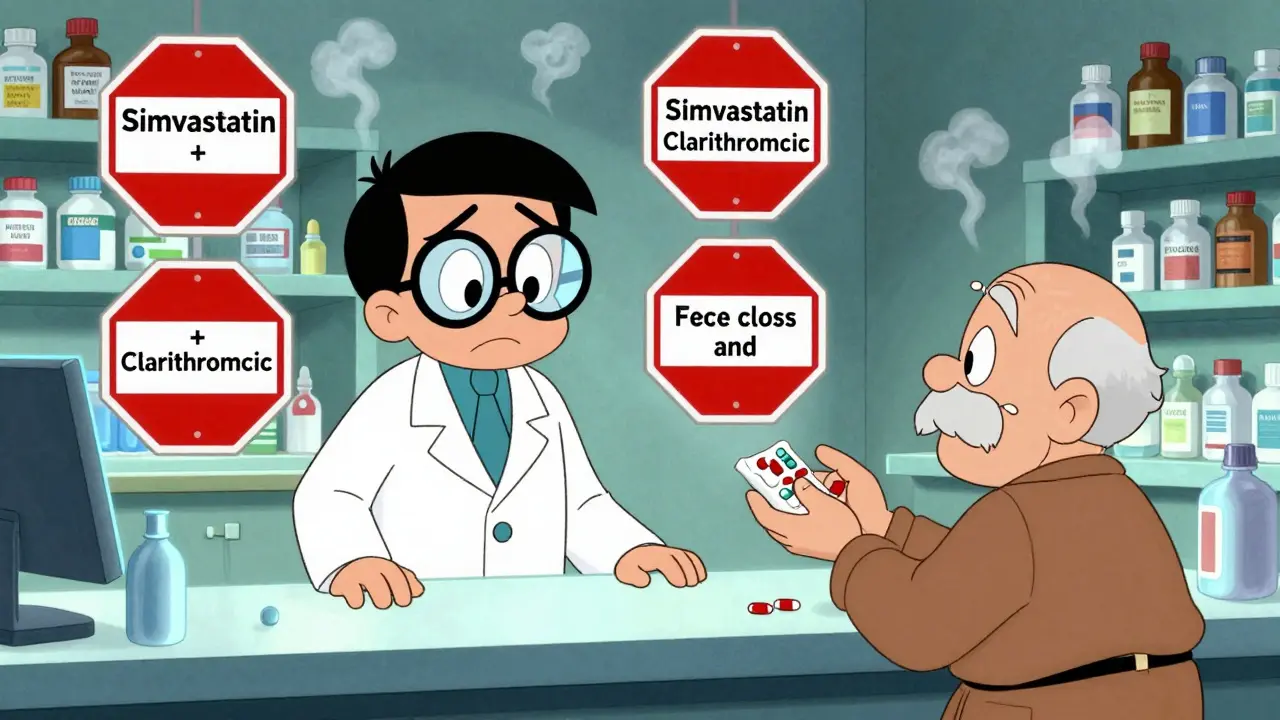
Simvastatin is one of the most common cholesterol drugs. Clarithromycin is a go-to antibiotic for sinus infections and bronchitis. Together, they can cause rhabdomyolysis-a condition where muscle tissue breaks down so fast that it floods your kidneys with toxic proteins. The result? Kidney failure. Sometimes death.
How? Clarithromycin blocks the CYP3A4 enzyme that normally breaks down simvastatin. Without that enzyme, simvastatin builds up to dangerous levels. Studies show creatine kinase levels can spike over 10,000 U/L-normal is under 200. That’s not a lab anomaly. That’s a medical emergency.
One 2016 investigation found that 52% of pharmacies missed this combination during test runs. At a CVS in Evanston, a pharmacist dispensed both drugs to a 68-year-old man. He woke up two days later with severe muscle pain and dark urine. He didn’t survive.
Tizanidine + Ciprofloxacin: Losing Consciousness on Purpose
Tizanidine is a muscle relaxer. Ciprofloxacin is a broad-spectrum antibiotic. Sounds harmless, right? Not when they’re paired.
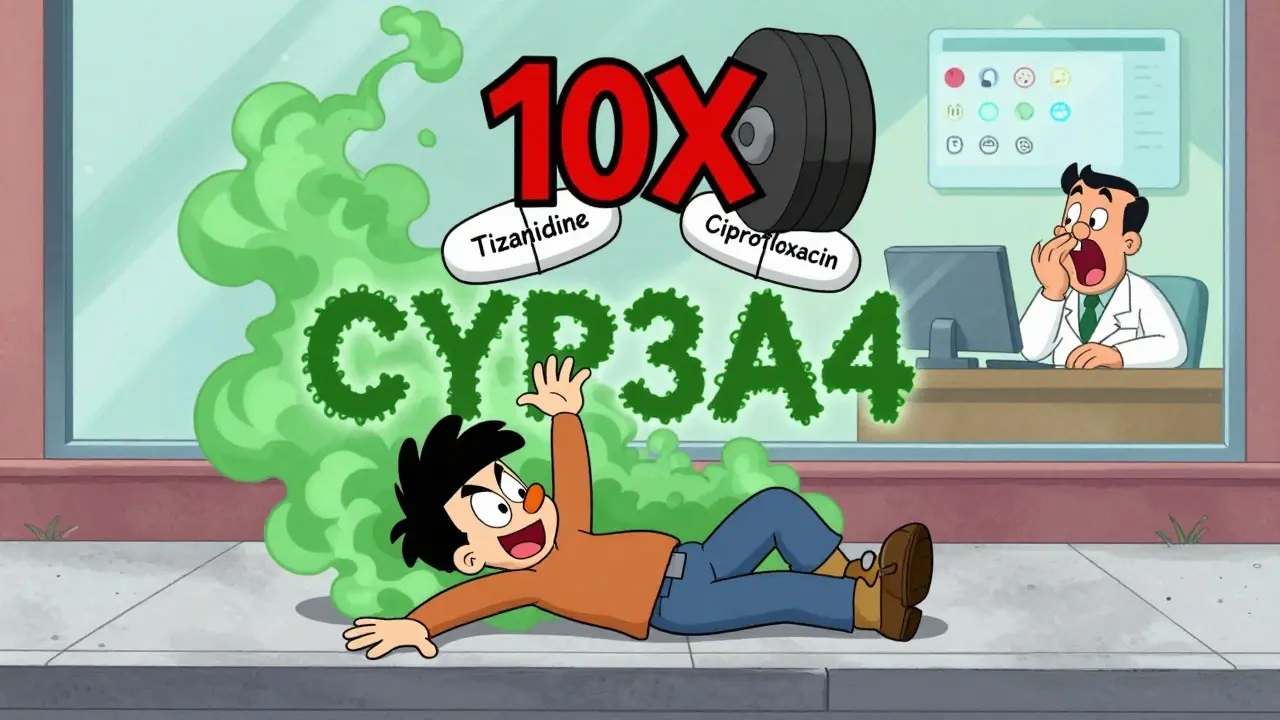
Ciprofloxacin shuts down the CYP1A2 enzyme that clears tizanidine from your body. Without it, tizanidine levels can jump 10-fold. That means extreme drowsiness, dizziness, low blood pressure-and sudden loss of consciousness. One patient fell while walking, hit his head, and died from a brain bleed.
This isn’t theoretical. The Chicago Tribune’s investigation tested this exact combo across 255 pharmacies. In more than half, no warning was given. Pharmacists didn’t even pause. They just filled the script.
Colchicine + Verapamil: A One-Two Punch for the Heart
Colchicine treats gout. Verapamil lowers blood pressure. Both are common. Both are safe alone. Together? They can be fatal.
Verapamil blocks the P-glycoprotein transporter that normally pushes colchicine out of your cells. Without that exit route, colchicine builds up to toxic levels. Symptoms start with nausea and diarrhea. Then come muscle weakness, irregular heartbeat, and multi-organ failure. Death can come within days.
The FDA has issued multiple warnings about this combo. Yet, in community pharmacies, it still slips through. Why? Because the computer doesn’t scream. It just whispers. And pharmacists, drowning in alerts, don’t hear it.
Clarithromycin + Ergotamine: The Migraine Trap
If you take ergotamine for migraines, you’re already in a high-risk group. Add clarithromycin, and you’re playing Russian roulette with your blood vessels.
Clarithromycin inhibits CYP3A4, which normally breaks down ergotamine. The result? Ergotism-a condition where blood vessels constrict so tightly they cut off circulation to your fingers, toes, even your heart and brain. You can lose limbs. You can have a stroke. You can die.
This combo isn’t rare. Migraine sufferers often get antibiotics for sinus infections. Pharmacists don’t always know their full med list. And if the system doesn’t flag it? The patient walks out with a prescription that could cost them a hand.
Oral Contraceptives + Griseofulvin: The Hidden Pregnancy Risk
Griseofulvin is an old-school antifungal used for stubborn athlete’s foot or nail infections. It’s not flashy. It’s not new. But it’s a silent saboteur of birth control.
Griseofulvin activates the CYP3A4 enzyme, which speeds up the breakdown of estrogen in oral contraceptives. Within days, hormone levels drop below the threshold needed to prevent ovulation. Studies show pregnancy rates jump to over 30% when these two are taken together.
And it’s not just pregnancy. If conception happens while on griseofulvin, the risk of birth defects skyrockets. The FDA lists this as a Category X interaction-meaning it’s absolutely contraindicated in pregnancy.
Yet, many pharmacists don’t even ask if a woman is on birth control. They assume she is. Or they assume she knows. She doesn’t. And by the time she finds out she’s pregnant, it’s too late.
Why This Keeps Happening
It’s not that pharmacists are careless. It’s that they’re overwhelmed.
A typical chain pharmacy processes a prescription in 2.3 minutes. That’s less than 140 seconds to verify identity, check allergies, review all medications, answer a question, and hit print. In that time, a pharmacist might get 15-20 computer alerts. Most are about harmless interactions-like ibuprofen and a mild blood pressure drug. They’re trained to ignore them.
But when the system doesn’t prioritize the deadly ones? That’s the problem.
Professor John Horn at the University of Washington redesigned alert systems to cut irrelevant warnings by 80%. He kept only the high-risk combos-like the five above-and made them mandatory for pharmacist review. In 18 months, detection rates jumped from 48% to 89%.
That’s not magic. That’s smart design.
Who’s Most at Risk?
Older adults. People taking five or more medications. Pregnant women. Those with kidney or liver disease.
One in three Americans over 65 takes four or more prescriptions daily. That’s a recipe for disaster if the system isn’t tuned to catch the worst combinations.
And it’s not just the elderly. Young people on birth control, athletes on muscle relaxers, migraine sufferers on ergotamine-they’re all sitting on ticking time bombs.
What You Can Do
You don’t have to wait for your pharmacist to catch it. You can catch it yourself.
- Always tell your pharmacist every medication you take-even OTC, supplements, and herbal remedies.
- Ask: “Is there any reason these two shouldn’t be taken together?” Don’t settle for “I don’t think so.”
- Know your high-risk drugs: statins, antibiotics like clarithromycin and ciprofloxacin, muscle relaxers, antifungals, and migraine meds.
- If you’re on warfarin, avoid amiodarone, fluconazole, and certain statins like simvastatin. Ask for alternatives like pravastatin or atorvastatin.
- Use a pill organizer with a printed med list. Bring it to every appointment.
And if your pharmacist doesn’t stop you? Walk out. Go to another pharmacy. Call your doctor. This isn’t paranoia. This is survival.
What’s Changing?
After the Tribune’s report, CVS and Walgreens updated their protocols. Now, high-risk combos like simvastatin + clarithromycin require a pharmacist signature. Some systems now use tiered alerts: Tier A (kill you), Tier B (hurt you), Tier C (annoy you). Only A and B trigger mandatory intervention.
The FDA’s new AI tools are starting to analyze not just drug pairs, but your age, kidney function, and other meds. That’s the future. But it’s not here yet.
Until then, you’re your own best defense.
Don’t Assume. Ask.
Medications save lives. But when they collide, they can end them. And the people meant to stop those collisions? They’re tired. Overworked. Under-supported.
That doesn’t mean you should trust them blindly. It means you should be their partner.
Know your drugs. Know the risks. Speak up. If your pharmacist doesn’t question a combination that could kill you, it’s not their fault alone. It’s the system’s. But you? You still have power. Use it.

Arlene Mathison
January 19, 2026 AT 14:26OMG I had simvastatin and clarithromycin prescribed together last year-my pharmacist didn’t say a word. I got so weak I couldn’t lift my coffee cup. Thank god I Googled it myself. This post saved my life. Everyone, PLEASE bring your med list to every appointment. Seriously.
Emily Leigh
January 19, 2026 AT 16:14So… let me get this straight… we’re blaming pharmacists for doing their job in a system designed to drown them in noise? Like, the real red flag is that we outsource life-or-death decisions to people paid $20/hour and then scream at them when they miss one out of 200 alerts? 😂
Carolyn Rose Meszaros
January 19, 2026 AT 22:02Y’all. I’m just sitting here with my tea and crying. This is so real. My grandma almost died from colchicine + verapamil. She didn’t even know they were dangerous together. 🥲 Please, if you’re on meds-ask. Ask again. And again.
Greg Robertson
January 21, 2026 AT 02:36I work in a pharmacy. We get 15-20 alerts per script. Most are about ibuprofen and aspirin. The system doesn’t prioritize. We’re not lazy-we’re exhausted. I’ve cried in the back room after missing a combo. This isn’t about us. It’s about the software. And the funding. And the staffing. We’re all stuck in this machine.
Renee Stringer
January 22, 2026 AT 21:37People who don’t read the fine print deserve what they get. If you can’t be bothered to know what’s in your medicine, don’t be surprised when your body rebels. This isn’t a failure of the system-it’s a failure of personal responsibility.
Nadia Watson
January 24, 2026 AT 09:39As someone who grew up in a household where medicine was never discussed, I didn’t know to ask. I thought if a doctor prescribed it, it was safe. I was 28 before I learned about CYP enzymes. Please, if you’re reading this, don’t wait until you’re in the ER. Talk to someone. Write things down. Even if you think it’s silly. I wish I had.
Courtney Carra
January 25, 2026 AT 16:01It’s not about the drugs. It’s about control. The system wants you dependent. It wants you confused. The real danger isn’t simvastatin and clarithromycin-it’s the illusion that someone else is watching out for you. Wake up. You are the only one who can protect your body. The rest? They’re just employees.
thomas wall
January 26, 2026 AT 00:52It is a profound indictment of modern healthcare that a nation with such advanced pharmaceutical science cannot implement a basic, prioritized alert system. The fact that pharmacists are expected to perform triage under such conditions is not merely negligent-it is ethically indefensible. The state must intervene. The market has failed.
Jacob Cathro
January 26, 2026 AT 01:02bro the FDA is just letting Big Pharma get away with this. they know these combos kill people. they just don’t care. why? because lawsuits are cheaper than fixing the software. also, why does every single one of these involve antibiotics? coincidence? i think not. #pharmabrainwash
Paul Barnes
January 27, 2026 AT 00:04Professor Horn’s study is peer-reviewed and replicated. The data is clear: reducing alert fatigue by filtering low-risk interactions increases detection of high-risk ones without increasing workload. This isn’t opinion. It’s systems engineering. The industry resists change because it’s easier to blame pharmacists than to fix the algorithm.
pragya mishra
January 28, 2026 AT 18:16Why are you all focusing on America? In India, people buy antibiotics over the counter with no prescription. No pharmacist. No system. No alerts. We die from this daily. You think your system is broken? We have no system at all. Stop being so privileged.
kumar kc
January 30, 2026 AT 13:11Griseofulvin + birth control = pregnancy. That’s it. No drama. No science. Just facts. Don’t be dumb.
Art Gar
February 1, 2026 AT 00:00The notion that patients should be their own ‘best defense’ is a neoliberal fantasy. If you cannot trust the professionals you pay to keep you alive, then society has collapsed. This isn’t empowerment. It’s abandonment.
Edith Brederode
February 1, 2026 AT 16:43I’m so glad someone finally said this. I showed my mom’s med list to my pharmacist last week and he paused for 5 full minutes. He called the doctor. He changed the script. I cried. Thank you for giving me the courage to speak up. 💙
clifford hoang
February 2, 2026 AT 09:39Did you know the FDA’s AI tools are being trained by the same companies that make the drugs? The ‘tiered alerts’? They’re coded to minimize liability, not save lives. They’ll flag a combo if it’s been in a lawsuit-but not if it’s just statistically deadly. This is all a cover-up. They’re using your meds to test how many people they can kill before Congress acts. 😈