
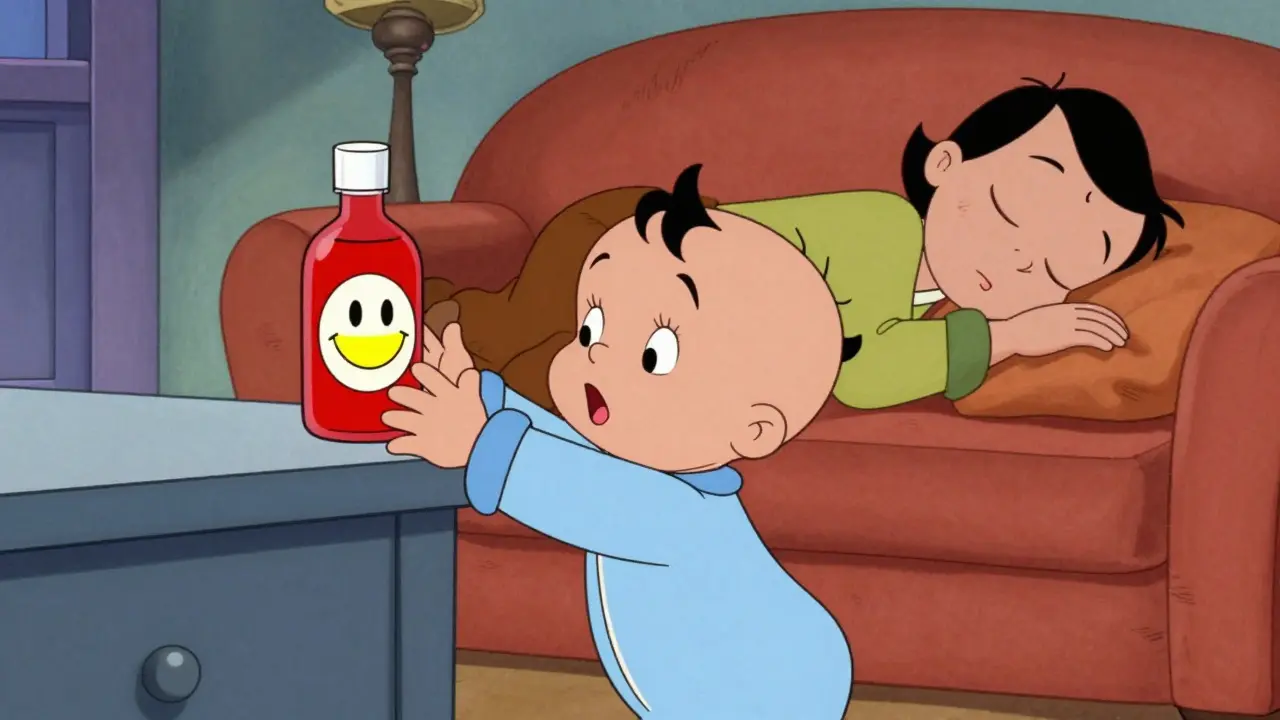
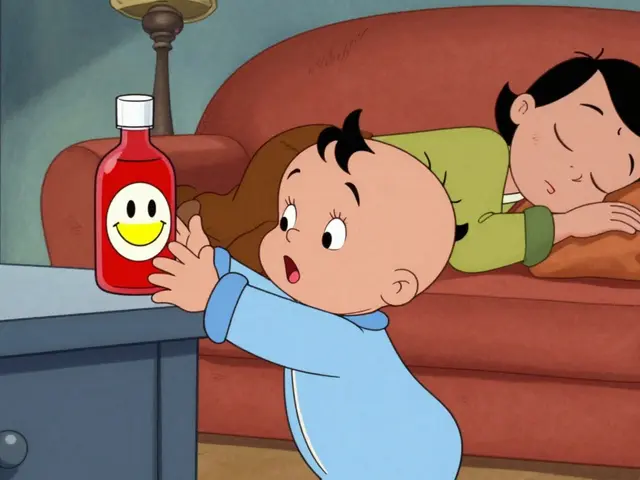
Every year, tens of thousands of children under five end up in emergency rooms because they got into medicine they weren’t supposed to. Not because they were trying to be rebellious. Not because they were curious about pills. But because medication was left within reach - on a nightstand, in an open drawer, even in a purse hanging off a chair. And in most cases, it was entirely preventable.
Why This Happens More Than You Think
Children under five are natural explorers. They put things in their mouths to learn about the world. A colorful liquid bottle, a shiny pill, a bottle that clicks when you twist it - to them, it’s not medicine. It’s a toy. A snack. A mystery. The Centers for Disease Control and Prevention (CDC) found that in 2010, emergency departments saw over 76,000 cases of children under five accidentally swallowing medication. That number hasn’t dropped as much as we’d hope. Even today, liquid medications like acetaminophen and diphenhydramine (Benadryl) are the top two culprits, making up nearly half of all cases. Why? Because they’re common, sweet-tasting, and often given in droppers or syringes that look like toys. Parents aren’t careless. Most are deeply attentive. But in the rush of a sick child, a tired parent, a busy morning - mistakes happen. One mom used a kitchen teaspoon because she couldn’t find the dosing cup. Another left her blood pressure pills on the dresser after a doctor’s visit. A grandparent gave the “children’s” version of Tylenol, not realizing the concentration was different from the infant formula. These aren’t rare stories. They’re everyday ones.What “Child-Resistant” Really Means
You’ve heard it before: “Use child-resistant caps.” But here’s the truth: child-resistant doesn’t mean child-proof. According to the Consumer Product Safety Commission, about 1 in 10 children can open a child-resistant cap by the time they’re 3.5 years old. That’s not a flaw in the cap - it’s a fact of child development. Toddlers are persistent. They watch. They copy. They figure things out. The PROTECT Initiative, launched by the CDC in 2008, was created to fix this. It doesn’t just rely on caps. It pushes for three things:- Packaging that makes access harder - like flow restrictors that slow down how fast liquid pours out
- Standardized dosing - all labels must use milliliters (mL), not teaspoons or tablespoons
- Education - the “Up and Away and Out of Sight” campaign teaches parents to store meds where kids can’t see or reach them
The Dosing Disaster: Why Kitchen Spoons Are Dangerous
This is the most common mistake - and the most avoidable. In 2022, a review of 1,200 medication errors showed that 78% were dosing mistakes. And 9 out of 10 of those involved using a kitchen spoon. Why? Because a teaspoon from your drawer isn’t a teaspoon from the pharmacy. A regular kitchen teaspoon holds anywhere from 3 to 7 milliliters. The dosing cup that comes with the medicine? Exactly 5 mL. That’s a 40% difference. Give a child 7 mL of acetaminophen when they should get 5 mL? You’ve just crossed into overdose territory. The fix is simple: always use the device that comes with the medicine. If it’s a syringe, use the syringe. If it’s a cup, use the cup. Never guess. Never improvise. Never use a spoon. And if you lose the device? Call your pharmacy. They’ll give you a new one - free.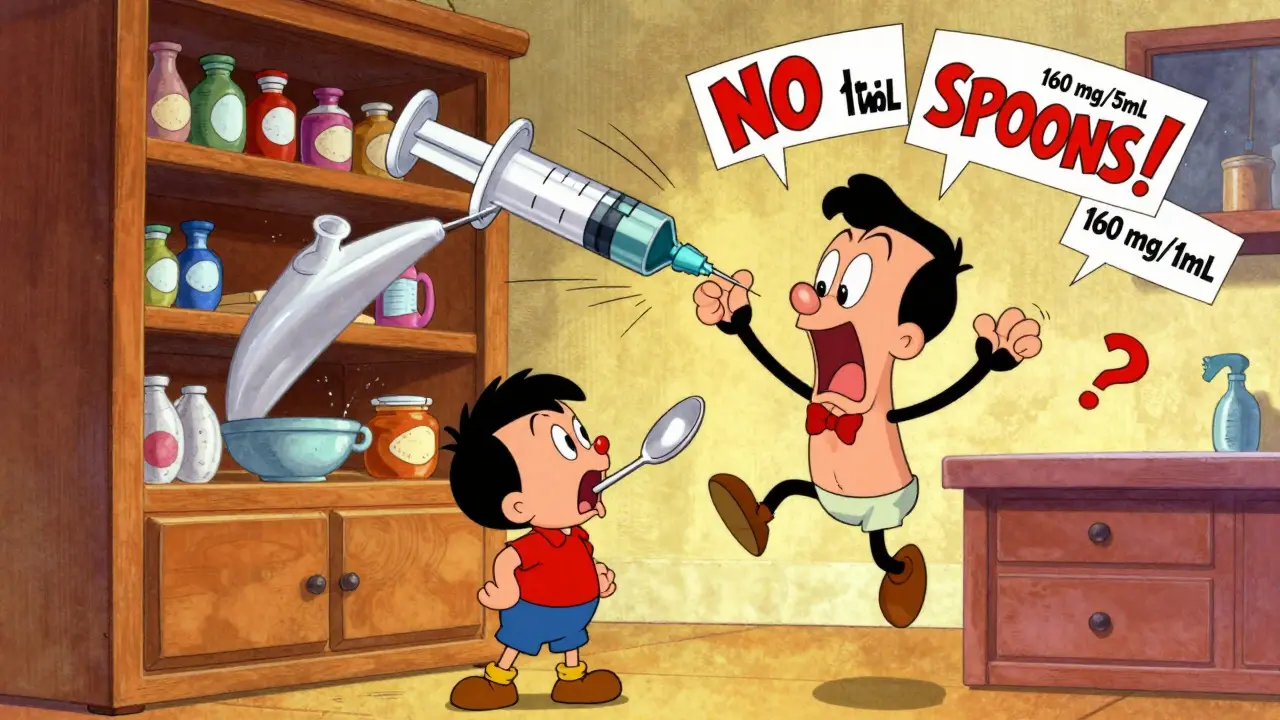
Where to Store Medicines (And Where Not To)
The bathroom cabinet? The nightstand? The kitchen counter? All bad ideas. Kids climb. They pull. They reach. And they’re faster than you think. The CDC recommends storing all medicines - even vitamins and supplements - in a locked cabinet, at least 4 feet off the ground. Not just “out of reach.” Out of sight and locked. Think about it: if your child can’t see it, they won’t think to look for it. If it’s locked, they can’t get to it even if they do see it. And if you forget to put it back? That’s when accidents happen. Make it a habit: after every dose, return it to the locked cabinet. Right then. No exceptions. One parent on Reddit shared how their 2-year-old got into blood pressure meds because they were left on the nightstand after a doctor’s visit. “Lesson learned,” they wrote. “Locked cabinet from now on.” That’s the kind of lesson no parent should have to learn the hard way.What to Do If Your Child Swallows Something They Shouldn’t
If you think your child swallowed medicine they weren’t supposed to - don’t wait. Don’t call a friend. Don’t Google symptoms. Don’t hope it’s “just a little.” Act immediately:- Take the container the medicine came in - even if it’s empty.
- Call Poison Control: 1-800-222-1222. It’s free, confidential, and available 24/7.
- Follow their instructions. They’ll ask what was taken, how much, and when.
- Do not induce vomiting unless told to.
- If your child is unconscious, having trouble breathing, or having seizures - call 911 right away.
The Hidden Problem: Confusing Concentrations
One of the most dangerous traps is this: infant vs. children’s acetaminophen. They look almost identical. Both are red bottles. Both say “Tylenol.” But the concentration is different. Infant drops are 160 mg per 5 mL. Children’s liquid is 160 mg per 5 mL too - wait, no. Actually, older versions of children’s liquid were 160 mg per 5 mL, but newer ones are 160 mg per 1 mL. That’s a 5x difference. If you give a child the “infant” drops using the children’s dosing cup, you’ve given them five times the intended dose. That’s liver damage. That’s emergency care. That’s hospitalization. Always check the label. Always match the concentration to the age. Always write down the strength if you’re unsure. And if you’re confused - call your pharmacist. They’re trained for this.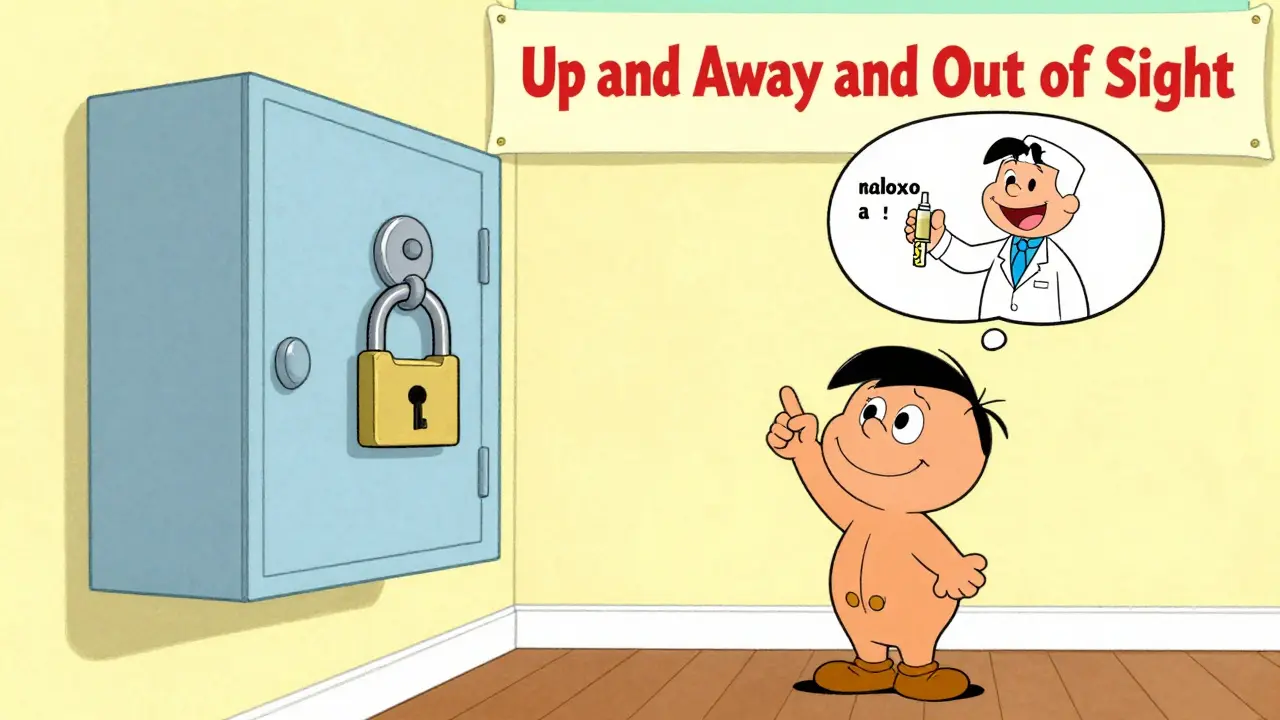
What’s Changing for the Better
There’s progress. The FDA now requires all pediatric liquid medications to use mL-only labeling. That’s huge. No more “teaspoon” confusion. In 2025, all liquid opioids will have flow restrictors built in - meaning even if a child opens the cap, they can’t pour out a dangerous amount quickly. The CDC’s PROTECT Initiative is expanding its “Up and Away” campaign into 12 new languages by 2026. That means more families - especially non-English speakers - will get clear, simple instructions. And in 2024, the American Academy of Pediatrics released new guidelines: if your child is prescribed an opioid, you should also get naloxone. And you should be taught how to use it. But here’s the catch: these changes only work if families know about them. And many still don’t.Your Action Plan: 5 Simple Steps
You don’t need a PhD in pharmacology to keep your child safe. Just these five things:- Use the right tool - only the dosing device that came with the medicine. No spoons. No cups. No guesses.
- Lock it up - all medicines, in a locked cabinet, at least 4 feet high.
- Check the label - always confirm the concentration (mg/mL) before giving any liquid medicine.
- Dispose safely - don’t flush. Don’t throw in the trash. Use a take-back program or mix with coffee grounds, seal in a bag, and toss.
- Know the number - save 1-800-222-1222 in your phone. Right now. Before you close this page.
Final Thought: It’s Not About Being Perfect
You’re not going to get it right every time. You’re tired. You’re stressed. You forget. That’s human. But you can build systems that protect your child even when you’re not perfect. Lock the cabinet. Use the syringe. Know the number. Keep naloxone if it’s prescribed. And if something goes wrong - call Poison Control immediately. They’re there to help, not to blame. Your child doesn’t need a perfect parent. They need a prepared one.What should I do if my child swallows medicine they shouldn’t have?
Immediately call Poison Control at 1-800-222-1222. Have the medicine container ready - even if it’s empty. Follow their instructions. Do not make your child vomit unless told to. If your child is unconscious, having trouble breathing, or having seizures, call 911 right away. For opioid overdoses, give naloxone if you have it.
Is child-resistant packaging enough to keep kids safe?
No. Child-resistant means it’s harder for a child to open - not impossible. Studies show about 10% of children can open these caps by age 3.5. Always store medicine in a locked cabinet, at least 4 feet off the ground, and out of sight. Caps are a backup, not the main safety measure.
Can I use a kitchen spoon to measure liquid medicine?
Never. Kitchen spoons vary in size and can hold anywhere from 3 to 7 milliliters. A standard dosing syringe or cup is exactly 5 mL. Using a spoon can lead to a 40% overdose. Always use the device that came with the medicine.
What’s the difference between infant and children’s acetaminophen?
Infant drops are 160 mg per 5 mL. Some children’s liquids are 160 mg per 1 mL - that’s five times stronger. Always check the label for concentration (mg/mL). Never assume they’re the same. If you’re unsure, ask your pharmacist.
Should I keep naloxone at home if my child is on opioids?
Yes. Since 2024, the American Academy of Pediatrics recommends co-prescribing naloxone with any opioid for children. It’s safe for kids and can reverse an overdose. Keep it locked but accessible to adults. Learn how to use it - intranasal spray is easiest. Ask your doctor for training.
astrid cook
January 26, 2026 AT 22:47My niece almost died because her grandma "guessed" the dose. She's fine now, but the hospital bill? $28,000. And guess what? The grandma still doesn't get it.
Stop being casual about medicine. It's not seasoning.
John O'Brien
January 27, 2026 AT 10:07Lock it up. Period. I keep mine in a locked toolbox in the closet. No one's getting in there except me. And if you're not doing that, you're just gambling with your kid's life.
April Williams
January 28, 2026 AT 21:30And don't even get me started on the "just call Poison Control" advice. Like that's a magic fix. You think they don't see this every single day? They're drowning in it.
Stop waiting for a hotline to save you. Be proactive. Lock it up. Use the syringe. Don't be the person who makes their kid a statistic.
Desaundrea Morton-Pusey
January 29, 2026 AT 10:34My cousin's kid took a Tylenol and was fine. He didn't even get sick. Why are we turning parenting into a military operation?
Also, who says you need to lock up vitamins? My kid eats gummy ones like candy. It's not a crime.
Murphy Game
January 30, 2026 AT 19:31Why do infant and children's Tylenol have different concentrations? To confuse you. To make you buy two bottles instead of one.
And naloxone? They're pushing it because they know kids are getting opioids from their parents' medicine cabinets. So now they sell you the antidote and make you feel safe while they keep selling the poison.
Wake up.
Kegan Powell
January 31, 2026 AT 21:59my daughter was 18 months when she got into my migraine meds. i didn't even know she'd opened the bottle until i found the cap on the floor and the bottle half empty.
we called poison control and they talked me through it like i was their own sister. no judgment. just help.
i used to think "it won't happen to me" but now i know better. it happens to everyone who thinks they're careful enough.
so if you're reading this and you're not locking your meds? do it today. not tomorrow. today. your kid deserves that much.
Harry Henderson
February 2, 2026 AT 04:15Stop being lazy. Stop being "I'm sure it's fine." You're not a chef, you're not a scientist, you're not a pharmacist. You're a caregiver. And caregivers follow the instructions.
Buy a lockbox. Buy a new syringe. Do whatever it takes. Your child doesn't care if you're tired. Your child just wants to live.
suhail ahmed
February 4, 2026 AT 02:33I've given these to neighbors, friends, even my sister-in-law in Delhi. She said it changed everything.
Also, we store meds in a high shelf inside a locked wooden box. No fancy cabinet needed. Just discipline.
It's not about money. It's about thinking ahead.
Andrew Clausen
February 4, 2026 AT 19:26There is no 5x difference. The FDA and AAP have confirmed this. The author is spreading misinformation. Please correct this.
Kirstin Santiago
February 4, 2026 AT 23:15Now I lock everything. Even my CBD gummies. My kids are 4 and 6. They’ll eat anything that looks like candy.
It’s not paranoia. It’s parenting.
Conor Flannelly
February 5, 2026 AT 16:01One thing we emphasize here is that grandparents often don't know the new rules. They grew up with medicine in the bathroom cabinet.
So we don't just educate parents - we educate the whole family. A quick chat with grandma can save a life.
Conor Murphy
February 6, 2026 AT 15:49It’s never the parent who meant to be careless. It’s always the one who was tired. The one who thought "just this once". The one who left it on the counter while they answered the door.
It’s not about blame. It’s about systems.
Lock it. Use the syringe. Save the number.
And if you’re reading this and you’re feeling guilty? Good. That means you care. Now go lock your meds.
Marian Gilan
February 8, 2026 AT 09:32those bright colors? the sweet flavors? the gummy shapes?
it's not an accident. it's marketing. big pharma knows toddlers love gummies. so they make medicine taste like gummy bears.
then they sell you the lockbox. then they sell you the syringe. then they sell you naloxone.
it's a cycle. and you're paying for it.
Paul Taylor
February 9, 2026 AT 18:55my kids are 2 and 5 and they can open cabinets climb chairs and pull down curtains but they can't reach the fridge
no fancy locks no expensive gadgets just a container and height
and yes i still use the dosing syringe even though my wife says it's annoying
she hasn't had to call poison control yet so i'm sticking with it
Candice Hartley
February 10, 2026 AT 13:28