
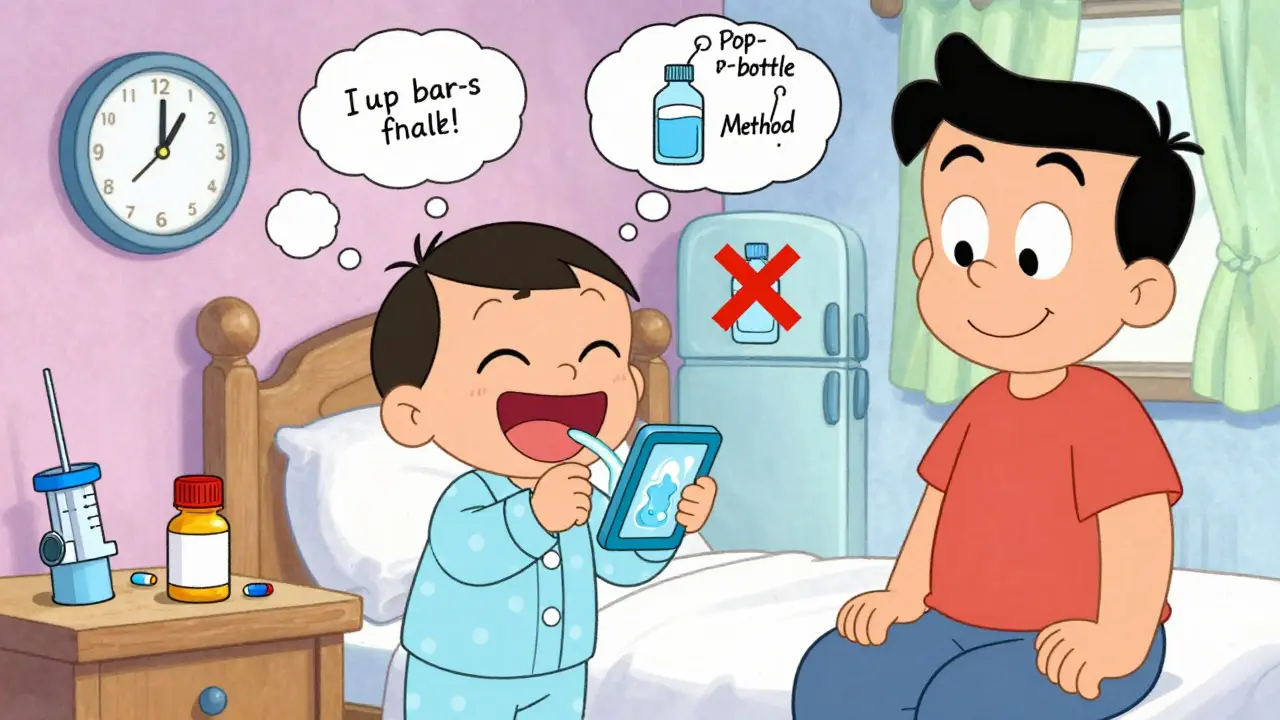
When your child is sick, the last thing you want is a battle over medicine. You’ve got two options in front of you: a sweet-tasting liquid in a syringe or a tiny pill that needs to be swallowed. Which one really works better? The answer isn’t as simple as "liquids are easier." In fact, the old assumption that kids can’t swallow pills is outdated-and choosing the wrong form might be making things harder for everyone.
Why Liquids Used to Be the Default
For decades, doctors and parents alike assumed that children under 6 couldn’t swallow pills. It made sense. Infants can’t chew. Toddlers gag easily. And who wants to deal with a crying child, a spilled dose, or a medicine that tastes like chalk? Liquid medications seemed like the safe, foolproof choice. They let you adjust the dose precisely by weight-critical for babies and small kids. You could even mix them with juice to hide the flavor. But here’s the problem: liquids aren’t as simple as they look. Studies show that 12-18% of parents mismeasure liquid doses, often using kitchen spoons instead of the provided syringe. That’s not just inconvenient-it’s dangerous. A little too much, or too little, can change how well the medicine works. And many liquid medicines need refrigeration. If you forget, or if the power goes out, the whole bottle can go bad in as little as two weeks.The Rise of Mini-Tablets and Better Solid Forms
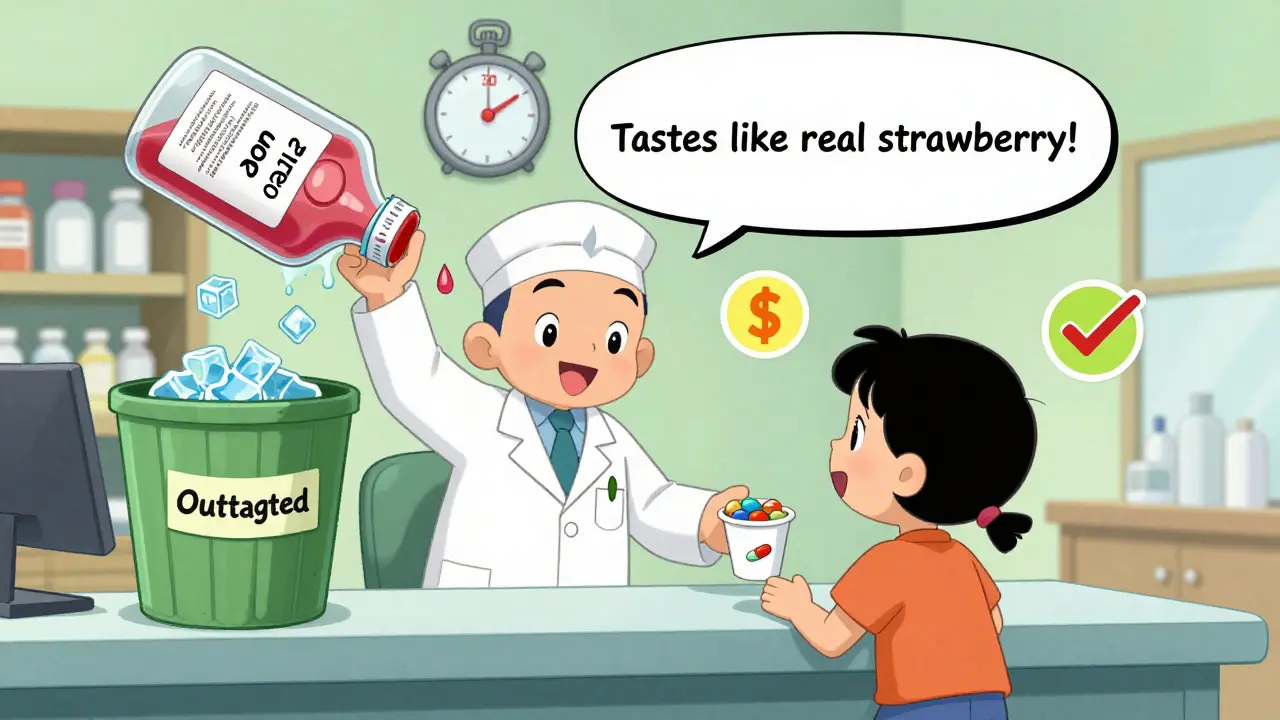
The game changed when pharmaceutical companies started making mini-tablets. These aren’t crushed pills. They’re specially designed, tiny tablets as small as 2mm wide-smaller than a grain of rice. They’re smooth, easy to swallow, and often coated to hide bitter tastes. In a 2012 study, researchers tested these on 60 kids aged 6 months to 6 years. The result? Children as young as 1 year old swallowed mini-tablets just as easily as they drank liquids. And in some cases, they preferred them. Modern pediatric tablets also come in orodispersible forms-they dissolve on the tongue in under 30 seconds, no water needed. Some are even flavored with real fruit extracts, not artificial "strawberry flavor" that tastes nothing like strawberries. Parents report fewer refusals and less mess. One mom on Reddit said, "My 4-year-old would rather swallow a mini-tablet than take the ‘strawberry’ antibiotic that tasted like chemicals."Why Tablets Are Often the Better Choice
Here’s what most people don’t realize: solid forms have major advantages over liquids when it comes to real-world use.- Stability: Liquid medicines often expire in 14-30 days after opening. Tablets last 2-3 years at room temperature.
- Dosing accuracy: No measuring errors. You give one tablet. Done.
- Cost: A 2021 NHS analysis found switching from liquid to tablet for just 10,000 pediatric prescriptions saves £7,842. For a hospital, that’s tens of thousands a year.
- Storage and travel: No refrigeration. No spills. No leaking bottles in your diaper bag.
- Adherence: A 2022 meta-analysis in JAMA Pediatrics found kids on tablet medications were 22% more likely to take their full course than those on liquids.
When Liquids Still Win
That doesn’t mean tablets are always better. There are clear cases where liquids are still the right call.- Babies under 6 months: They can’t swallow anything solid. Liquids are necessary.
- Medicines needing exact dosing: Drugs like levothyroxine (for thyroid) or warfarin (a blood thinner) require precision down to 0.1 mL. Tablets can’t be split accurately enough for this.
- Children with swallowing disorders: If your child has autism, cerebral palsy, or another condition affecting swallowing, liquids may be safer and easier.
Training Your Child to Swallow Pills
The biggest barrier to tablets isn’t the medicine-it’s the fear. Both parents and kids worry about choking. But here’s the truth: choking incidents with pediatric tablets are extremely rare. The FDA tracked reports from 2010 to 2020 and found fewer than 0.002% of cases involved actual choking. The real issue? Lack of training. Most parents never learn how to teach their child to swallow pills. It’s not magic. It’s practice. Start around age 3-4. Use mini-marshmallows or small bread balls. Make it a game. Try the "pop-bottle method": Have your child take a sip from a water bottle, then place the tablet on their tongue just before they swallow. Most kids get it on the first try. By age 6, most can swallow standard 6-8mm tablets. A 2023 report from BC Children’s Hospital found that when parents were shown how to do this, over 90% of children aged 3 and up succeeded. That’s not luck. It’s technique.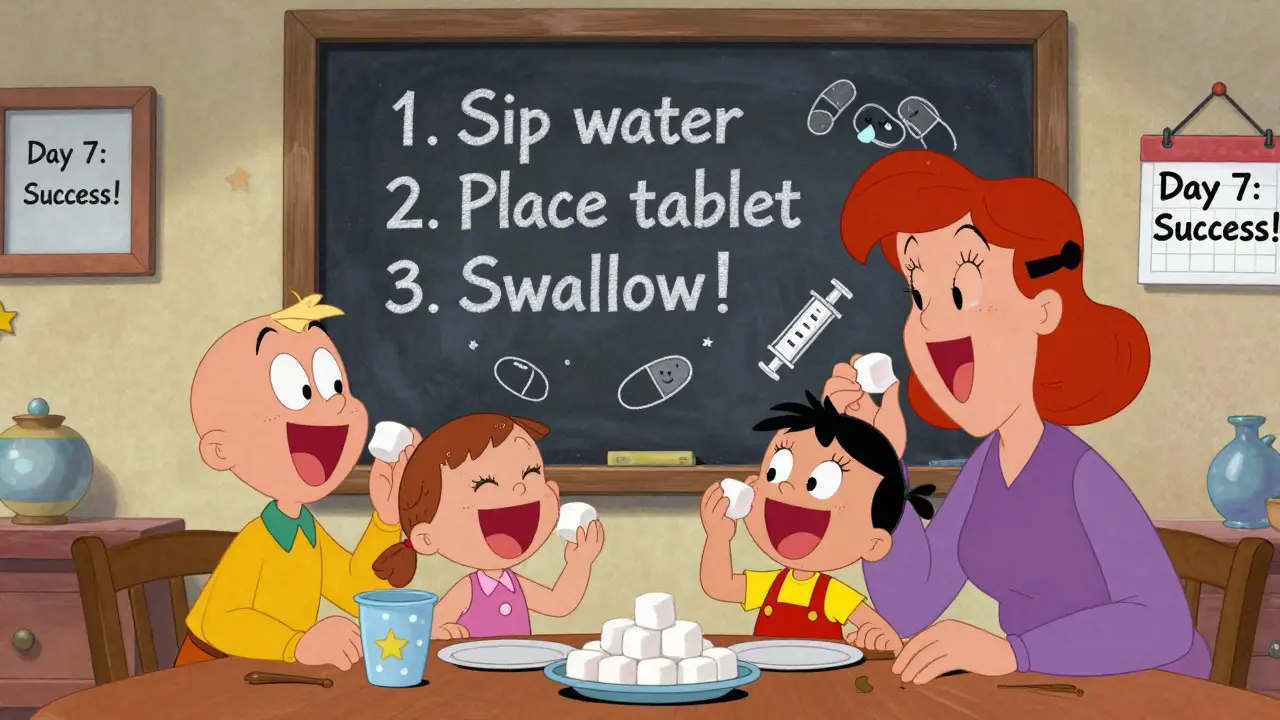
What Your Pharmacist Won’t Tell You
Here’s the hidden problem: 42% of pediatric medications lack official dosing guidelines for tablets in children under 6. That means even if you want to switch, your doctor might not know how to prescribe it. They default to liquid because it’s what’s on the label. Ask your pharmacist: "Is there a tablet version of this?" and "Can you check if it’s approved for my child’s age?" Many pharmacies now stock pediatric mini-tablets, even if they’re not listed in the computer system. You might be surprised. Also, don’t assume all "flavored" liquids are tasty. A 2023 study found that kids reject liquids labeled "strawberry" if they don’t actually taste like real strawberries. The same goes for "cherry" or "grape." Real flavor matters.What to Do Next
If your child is over 2 years old and doesn’t have a swallowing disorder:- Ask your doctor: "Is there a tablet version of this medication?"
- Check with your pharmacist: "Can you get me the mini-tablet form?"
- Practice swallowing at home with small, soft items like mini-marshmallows.
- Don’t crush tablets unless instructed. It can ruin time-release formulas or change how the drug works.
- Store tablets at room temperature. Keep liquids refrigerated if required.
Final Thought
The idea that kids need liquids isn’t based on science-it’s based on habit. The truth? Children are more capable than we think. With the right tools and a little patience, most kids can handle tablets. And for parents? That means less mess, less waste, fewer trips to the pharmacy, and more confidence that your child is getting the right dose every time.It’s not about avoiding liquids entirely. It’s about choosing the right tool for the job. And for many kids, that job is a tiny tablet-not a syringe.
Can my 2-year-old swallow a tablet?
Yes, many 2-year-olds can swallow small, age-appropriate mini-tablets with proper training. The American Academy of Pediatrics says children as young as 2 can be taught to swallow tablets using techniques like the "pop-bottle method." Start with practice using soft foods like mini-marshmallows before trying actual medication.
Are liquid medications more accurate than tablets?
For precise dosing, liquids can be more accurate-down to 0.1 mL-especially for infants. But for most children over 1 year, tablets offer better accuracy because they eliminate measurement errors. Studies show 12-18% of parents mismeasure liquid doses, often using kitchen spoons. Tablets remove that risk entirely.
Why do some pediatricians still prescribe liquids by default?
Many doctors stick with liquids because that’s what they were trained to do, and because parents often ask for them. A 2021 survey found 62% of U.S. pediatricians still automatically prescribe liquids for kids under 8. But this is changing. New guidelines from the EMA and FDA now encourage solid forms for children over 3, and more tablets are being developed.
Is it safe to crush a tablet and mix it with food?
Only if your doctor or pharmacist says it’s okay. Crushing tablets can destroy time-release coatings, change how the drug is absorbed, or make it less effective. Some medications become unsafe when crushed. Always check before doing this. If your child can’t swallow pills, ask for a mini-tablet or liquid version instead.
Which lasts longer: liquid or tablet medicine?
Tablets last much longer. Most liquid medications expire 14-30 days after opening and often need refrigeration. Tablets typically stay stable for 2-3 years at room temperature. That means fewer wasted doses and less need to refill prescriptions.
Do tablets cost more than liquids?
No-tablets usually cost less. A 2021 UK study found switching from liquid to tablet prescriptions saved £7,842 per 10,000 pediatric prescriptions. Liquid formulations require preservatives, flavoring, and refrigerated storage, which all add cost. Tablets are simpler to produce and store, making them cheaper per dose.
What if my child refuses to swallow a tablet?
Don’t force it. Try again later with practice using soft foods. Use the "pop-bottle method"-have your child sip from a water bottle while placing the tablet on their tongue. Many kids get it on the first try. If they still struggle, ask your doctor about orodispersible tablets (they dissolve on the tongue) or a different formulation. There’s almost always an alternative.
Hugh Breen
March 14, 2026 AT 06:50Byron Boror
March 14, 2026 AT 19:15Lorna Brown
March 15, 2026 AT 08:16Rex Regum
March 16, 2026 AT 11:34Jimmy V
March 17, 2026 AT 01:54Scott Smith
March 18, 2026 AT 12:54Sally Lloyd
March 20, 2026 AT 07:18Adam M
March 20, 2026 AT 17:06Rosemary Chude-Sokei
March 21, 2026 AT 00:28Noluthando Devour Mamabolo
March 21, 2026 AT 04:01Leah Dobbin
March 22, 2026 AT 12:58Ali Hughey
March 22, 2026 AT 22:56