
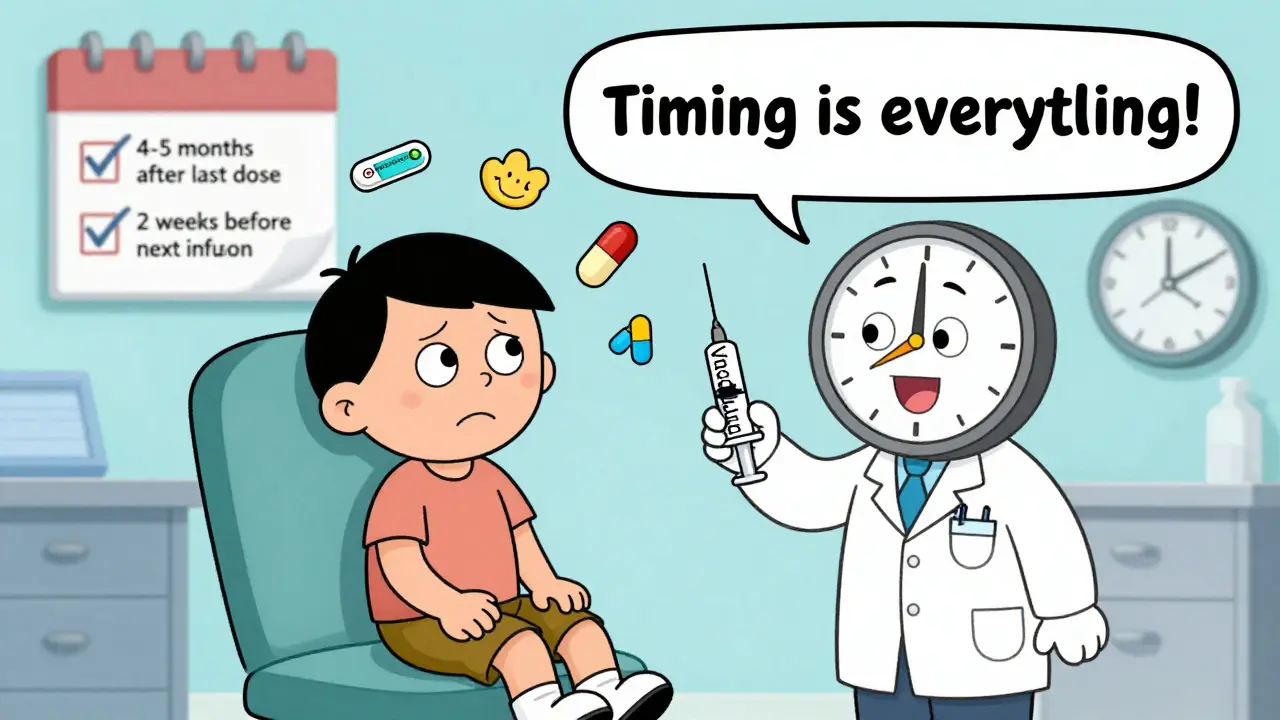
Getting vaccinated isn’t the same for everyone. For people with autoimmune diseases or those on medications that weaken the immune system, the timing and type of vaccine can make a huge difference in whether it works at all. It’s not just about getting the shot - it’s about vaccines being given at the right moment in a treatment cycle, or before therapy even starts. And even then, protection might not be as strong as it is for someone with a fully functioning immune system.
Why Vaccines Don’t Always Work the Same Way
When someone takes drugs like rituximab, methotrexate, or high-dose prednisone, their body’s ability to respond to vaccines drops - sometimes by more than half. Studies show that solid organ transplant recipients, for example, produce 56% fewer antibodies after two doses of an mRNA COVID-19 vaccine compared to healthy people. That doesn’t mean the vaccine is useless. It means the immune system needs extra help - more doses, better timing, or both. The problem isn’t just the medication. It’s when you get the shot relative to the drug schedule. A vaccine given while your immune cells are being wiped out won’t trigger much of a response. But if you give it just before or after treatment, you might get the protection you need.Timing Is Everything: What the Guidelines Say
Major medical groups - the CDC, IDSA, ACR, NCCN, and MSK - all agree on one thing: vaccinate before starting immunosuppression if you can. But they don’t always agree on how long to wait after.- If you’re starting a drug like rituximab (which wipes out B-cells), wait at least 4-5 months after your last dose before getting a vaccine. Then, get it 2-4 weeks before your next infusion. Some experts, like those at Memorial Sloan Kettering, say wait 9-12 months for the best shot at a strong response.
- For methotrexate, hold the drug for two weeks after getting the flu vaccine. This simple pause can boost your antibody levels significantly.
- If you’re on prednisone at 20 mg or more per day, delay non-flu vaccines until you’re down to a lower dose. High steroids blunt immune responses across the board.
- For transplant patients, the window is narrow: get vaccines at least 2 weeks before transplant, or wait 3 months after. The CDC says 1 month after is okay, but IDSA is more cautious.
Where the Guidelines Clash - And Why It Matters
There’s no single rule that fits every patient. That’s because diseases and treatments vary so much. Take B-cell depleting therapies. The National Comprehensive Cancer Network says for patients with chronic lymphocytic leukemia: "Vaccinate when available." Meanwhile, MSK says: "Wait until lymphocyte counts recover." Why the difference? One group prioritizes speed - especially during a surge in infections. The other prioritizes maximum effectiveness. Both have valid points. During a flu or COVID outbreak, getting the vaccine now might be better than waiting months for a slightly better response later. The IDSA’s 2024 guidelines put it plainly: if community transmission is over 100 cases per 100,000 people, don’t delay. Even if you’re on rituximab. The risk of getting sick outweighs the risk of a weaker vaccine response.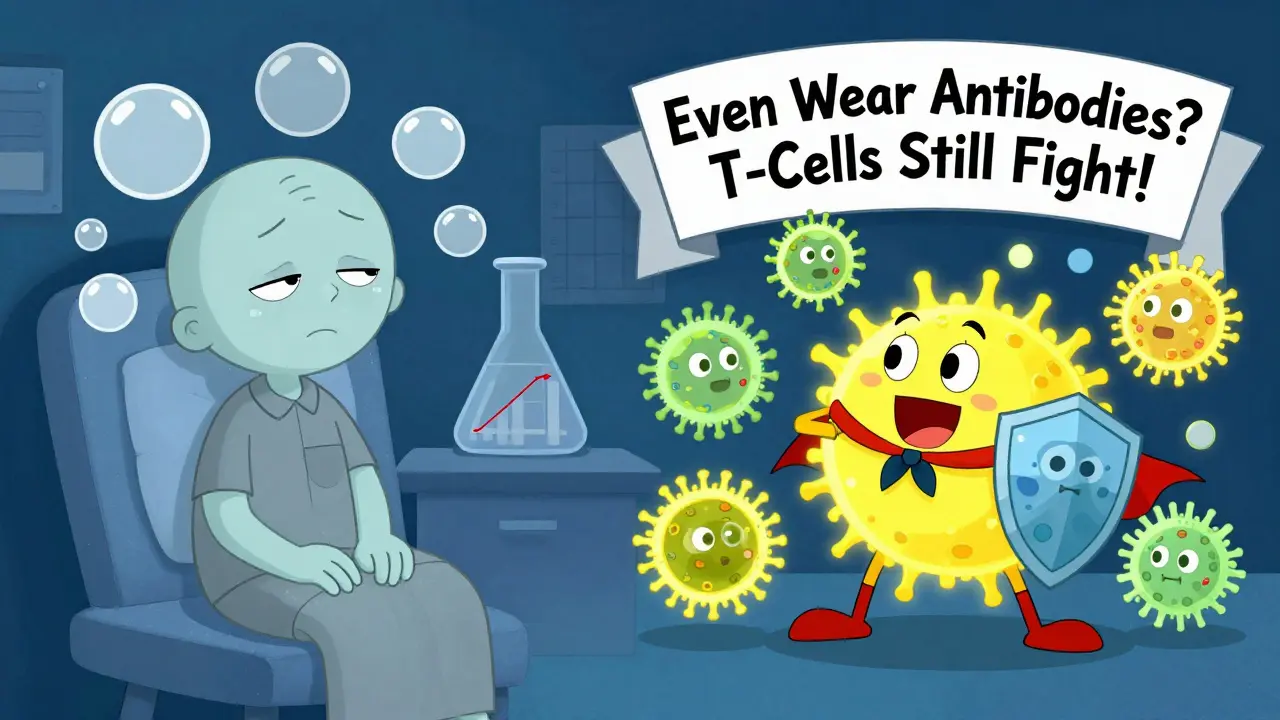
What About T-Cells? The Hidden Layer of Protection
Antibodies aren’t the whole story. Even if your antibody levels are low after vaccination, your T-cells might still be fighting off infections. That’s why some people on immunosuppressants still avoid serious illness - even if tests show they didn’t "respond" to the vaccine. The CDC updated its advice in November 2023 to reflect this. They now say: if you’re at high risk and can’t wait, vaccinate even during B-cell depletion. The T-cell response might still protect you. This is a game-changer. It means the old rule - "don’t vaccinate during treatment" - is too rigid. Real-world outcomes matter more than lab numbers.Practical Challenges in the Clinic
Ideally, your rheumatologist, oncologist, and primary care doctor all talk to each other. In reality? They often don’t. A 2022 study found that nearly half of transplant centers fail to follow recommended vaccine timing. Why? Lack of communication. Patients move between specialists. Schedules get missed. Medication holds aren’t coordinated. And it’s not just about vaccines. Chemo cycles, infusion schedules, and flare-ups make timing unpredictable. For someone on obinutuzumab, the best time to vaccinate is the week before the next chemo dose - when white blood cell counts are highest. But if the patient is in the hospital for an infection? The window closes.
What You Can Do - A Simple Action Plan
If you’re on immunosuppressive therapy, here’s what to do:- Ask your doctor: "Which drugs am I on, and how do they affect vaccines?" Write it down.
- Get all routine vaccines (flu, pneumococcal, tetanus, hepatitis B) before starting treatment if possible.
- If you’re already on treatment, ask: "When is the best time to get my next vaccine?" Don’t assume it’s the same for everyone.
- For rituximab: Plan ahead. Get vaccines 4-5 months after your last dose, and schedule them 2-4 weeks before your next one.
- For methotrexate: Ask if you can pause it for two weeks after your flu shot. It’s safe and helps.
- Keep a personal vaccine log. Note the date, type, and your drug schedule around it.
The Future: Personalized Timing
Right now, we’re guessing. We use fixed time intervals because we don’t have better tools. But that’s changing. The NIH just launched a $12.5 million trial in January 2024 to test whether measuring CD19+ B-cell counts can tell us exactly when to vaccinate after rituximab. If it works, we’ll move from "wait six months" to "wait until your B-cells hit 100 cells/µL." That’s precision medicine. Until then, the best approach is flexibility. A 6-month wait might be ideal - but if you’re about to travel, or if flu is spreading fast in your town, getting the shot now is better than waiting for perfection.Final Thought: It’s Not All or Nothing
A vaccine that gives you 50% protection is still better than zero. A partial response might keep you out of the hospital. It might mean you don’t need to isolate every time there’s a cold going around. The goal isn’t to be perfectly protected. It’s to be as protected as possible - given your disease, your meds, and your life. Don’t skip vaccines because you think they won’t work. Talk to your doctor. Plan ahead. And don’t be afraid to ask: "What’s the safest time for me?"Can I get vaccines while on rituximab?
Generally, no - not during active treatment. Rituximab wipes out B-cells, which are needed to make antibodies. The best time is 4-5 months after your last dose and 2-4 weeks before your next one. But if you’re at high risk for infection (like during a flu or COVID surge), some experts say get the vaccine anyway - even if your response will be weaker. T-cells might still help.
Should I stop my methotrexate to get the flu shot?
Yes, for two weeks. The American College of Rheumatology recommends holding methotrexate for 2 weeks after the flu vaccine. This simple step can improve your immune response without triggering a disease flare. Talk to your rheumatologist - this is a common and safe adjustment.
Do I need more than one dose of the COVID vaccine if I’m immunosuppressed?
Yes. The CDC and IDSA recommend additional doses for immunocompromised people. This includes a primary series of 3 doses (instead of 2) and annual boosters. Waning immunity is common in this group, so staying up to date is critical. Don’t assume one dose is enough.
Is it safe to get live vaccines if I’m immunosuppressed?
No. Live vaccines - like MMR, varicella, or the nasal flu spray - are not safe for people on immunosuppressive therapy. They can cause serious infection. Stick to inactivated or mRNA vaccines only. Always check with your doctor before getting any vaccine.
Why do some guidelines say to wait 6 months after rituximab, but others say 9-12 months?
It’s a trade-off between safety and effectiveness. Six months is the minimum time most people start rebuilding B-cells. But full recovery can take 9-12 months. Waiting longer means a better vaccine response - but if you’re at high risk for infection, waiting too long could be dangerous. Experts use 6 months as a practical middle ground. Your doctor can help decide based on your disease and exposure risk.
Can I get vaccinated during a disease flare?
It’s risky. During a flare, your immune system is already overactive, and adding a vaccine might make symptoms worse. But if you’re at high risk for infection (e.g., during a pandemic), the benefit may outweigh the risk. Always talk to your specialist - they’ll weigh your individual situation.
What if my doctor doesn’t know the timing rules?
Bring the guidelines. Print out the IDSA 2024 recommendations or the CDC’s page on immunocompromised vaccination. Many primary care doctors aren’t trained on these nuances. Your rheumatologist, oncologist, or transplant team should know - ask them to write a note or call your doctor. You’re your own best advocate.
Are vaccines less effective for all autoimmune diseases?
No. Effectiveness varies by drug, not disease. Someone on low-dose prednisone for rheumatoid arthritis might respond almost normally. Someone on high-dose steroids and rituximab for lupus might have a very weak response. It’s the medication, not the diagnosis, that matters most.
Michael FItzpatrick
February 26, 2026 AT 05:04Let me tell you something wild - vaccines for immunosuppressed folks aren’t just a medical footnote, they’re a goddamn opera. I’ve seen people get slapped with a "don’t vaccinate" sticker like they’re radioactive, when really, it’s about *timing*, not avoidance. It’s like telling a chef not to cook because the oven’s on a timer. You don’t shut down the kitchen - you adjust the heat. And honestly? The fact that T-cells are still doing their thing even when antibodies are MIA? That’s the plot twist no one saw coming. We’re not talking about failure here. We’re talking about adaptation. Evolution. Survival.
And don’t get me started on the bureaucratic chaos. One doc says wait six months, another says nine, and your primary care doc is Googling "rituximab vaccine" while you’re sitting there holding your flu shot like it’s a bomb. We need a damn app for this. Not a pamphlet. An app.
Also - stop calling it "immunocompromised" like it’s a diagnosis. It’s a phase. A season. A temporary state of being. We’re not broken. We’re just running on custom firmware.
Brandice Valentino
February 27, 2026 AT 20:07so like… i read this whole thing and i’m just like… why do we even have guidelines? like, if the science is this messy, shouldn’t we just let people do whatever? i mean, i got my flu shot while on methotrexate and i’m still here. also, who even is IDSA? sounds like a secret society. and why does msK get to be the cool kid? they have like, a whole wing named after them. are they the new stanford? anyway, i’m just saying… maybe we’re overthinking this. like, if i can get a tattoo while on prednisone, why not a vaccine? 🤷♀️
Larry Zerpa
March 1, 2026 AT 00:02Let’s dismantle this with precision. The entire premise here is built on a flawed assumption: that antibody titers are the gold standard for vaccine efficacy. They’re not. They’re a proxy. A noisy, overinterpreted, clinically irrelevant proxy. T-cell responses are measurable, reproducible, and far more predictive of real-world protection - yet they’re ignored because they’re harder to test. This isn’t medicine. It’s marketing dressed in white coats.
And the suggestion to vaccinate "during a surge"? That’s not flexibility - that’s desperation masquerading as pragmatism. If you’re relying on a 50% reduced response as your primary defense, you’re not being smart - you’re being reckless. You’re gambling with organ failure, ICU stays, and long-term damage. There’s no such thing as "partial protection" - there’s only protection, and non-protection. Everything else is placebo with a prescription.
Also - the NIH trial? A decade too late. We’ve known B-cell recovery varies individually since 2018. The fact that we’re still using fixed intervals instead of biomarkers is a failure of institutional inertia, not scientific uncertainty. And don’t even get me started on the "vaccine log." That’s not a tool. It’s a Band-Aid on a hemorrhage.
Gwen Vincent
March 1, 2026 AT 17:39I just wanted to say thank you for writing this. I’ve been on rituximab for 3 years now, and every time I asked about vaccines, I got shrugged shoulders. I didn’t know about the T-cell thing until now. It’s crazy how much of this feels like guesswork - and how little we’re told. I’ve been scared to get anything since my transplant, but reading this… it made me feel less alone.
I’m going to talk to my oncologist next week. I’ve got my flu shot scheduled for the week before my next infusion. I’m not going to wait for perfection anymore. I’m going for "as much as I can get."
Also - if anyone else has a vaccine tracker spreadsheet, I’d love a copy. I’m making one. And yes, I’m including the moon phase. Just in case.
Nandini Wagh
March 2, 2026 AT 03:55Oh honey. You really think this is about science? 😂
Let me guess - next they’ll tell us the moon controls our immune system. First, vaccines. Then, they’ll say sunlight is a cure. Then, they’ll make us wear copper bracelets. I’ve been on methotrexate since 2019. I got the flu shot. I got the COVID shot. I got the pneumonia shot. And guess what? I still got sick. Twice. So now I just laugh. They want us to believe in magic numbers - 2 weeks, 4 months, 9 years - but I’ve seen the same person get the same shot 3 times and still end up in the ER. So I’m done. I’m not a lab rat. I’m a person. And my body? It doesn’t care about your guidelines.
Also - who funds these studies? Big Pharma? Yeah. Right.
Holley T
March 3, 2026 AT 17:35I’ve been thinking about this for months, and honestly? The whole system is broken. We have people on life-saving immunosuppressants - people who literally cannot survive without these drugs - and we’re treating their vaccination like it’s a scheduling conflict at a yoga studio. "Oh, you’re on rituximab? Let’s see… next available slot is 6 months from now… unless it’s a Tuesday, then it’s 8 months… unless you’re over 60, then we recommend 12… but only if you live north of the Mason-Dixon." And don’t get me started on the "hold methotrexate for two weeks" advice. Two weeks?! That’s a lifetime for someone with RA. I had a flare so bad I couldn’t hold a coffee cup. Two weeks of pain, two weeks of sleepless nights, two weeks of my kid asking why Mommy can’t hug her - and for what? A 15% increase in antibody titers? That’s not a win. That’s a trade-off that only makes sense if you’re a statistician who’s never held a crying child.
Meanwhile, the CDC is still using 2020 guidelines. The science moved on. The patients moved on. But the guidelines? They’re stuck in a PowerPoint from 2017.
And yet, somehow, we still act like this is rational. Like this is care. It’s not. It’s bureaucracy with a stethoscope.
Ashley Johnson
March 3, 2026 AT 19:53So… are we sure these vaccines aren’t just making us more vulnerable? Like… what if the whole "weakened immune system" thing is just a cover-up? What if the real reason people get sick after vaccines is because the vaccines are changing their DNA? I heard a guy on YouTube who used to work for Pfizer - he said they inject nanoparticles that latch onto your cells and make them forget how to fight. And don’t even get me started on the microchips. I’ve been reading the FDA documents. They say "immune response" - but what if that’s code for "we’re monitoring your immune system"? I’m not saying I won’t get the shot… but I’m not taking it from a hospital. I’m getting it from a friend who works at a pharmacy. And I’m holding my breath while I do it. 😷
Lillian Knezek
March 4, 2026 AT 09:08lol i just got my third covid shot and i’m like… am i a guinea pig? 🤔💉
my doc said "you need it" but then whispered "don’t tell anyone i said that"
also i think the government is using our antibodies to power satellites. i saw a tweet.
send help. or a vaccine. idk anymore. 😭
Christopher Brown
March 4, 2026 AT 21:39Europe’s doing this wrong. We don’t need guidelines. We need discipline. If you’re on immunosuppressants, you don’t get special treatment. You get less. You get fewer shots. You get no delays. You get no exceptions. America’s soft. We treat patients like fragile china. In the real world, you adapt or you die. Vaccines aren’t a right - they’re a tool. Use them when you can. Don’t whine when you can’t. Stop asking for permission. Just survive.
Sanjaykumar Rabari
March 6, 2026 AT 16:17They say wait 6 months. But what if you can't wait? What if your son is going to school? What if your wife is pregnant? What if you have to go to the market? Who decides? Doctors? Who are doctors? They are paid by companies. They are not your friends. You are alone. You must be smart. You must watch. You must wait. You must not trust. The vaccine is not for you. It is for the system. Remember this.
Kenzie Goode
March 8, 2026 AT 09:48I just cried reading this. Not because I’m sad - because I’m seen.
I’ve been on 20mg of prednisone for 7 years. I’ve had 14 vaccines. I’ve been told "no" 8 times. I’ve been told "maybe" 5 times. I’ve been told "just go ahead" once - and I did. I got the flu shot during a flare. I got sick anyway. But I didn’t end up in the hospital. And I didn’t lose my job. And I didn’t cancel my daughter’s birthday party.
So here’s what I’m doing now: I’m not waiting for the perfect time. I’m waiting for the *possible* time. And when it comes? I show up. I show up with my log. I show up with my questions. I show up with my fear. And I show up for my kids.
Because sometimes, "as protected as possible" isn’t about science.
It’s about love.