

DVT Risk Assessment Tool
Travel DVT Risk Assessment
This tool helps you determine your DVT risk during long-haul travel based on your medical history. The American College of Chest Physicians categorizes travelers as average risk or high risk based on several factors.
Your Risk Assessment
Getting on a plane while on blood thinners doesn’t have to be scary-but it does require planning. If you’re taking warfarin, rivaroxaban, apixaban, or any other anticoagulant, long-haul flights, train rides, or car trips longer than 4 hours can raise your risk of deep vein thrombosis (DVT). The good news? You can fly safely. The key is knowing what to do before, during, and after your trip-not just popping pills and hoping for the best.
Why Travel Increases DVT Risk
Sitting still for hours is the real problem, not economy class. The term “economy class syndrome” is outdated. It’s not about legroom; it’s about immobility. When you sit for too long, blood pools in your legs. That’s when clots start forming. For someone on anticoagulants, this risk is already managed-but only if you’re taking your medication exactly as prescribed. The CDC says the chance of a clot on a long flight for a healthy person is about 1 in 4,656. But if you have one or more risk factors-like being over 40, having a BMI over 30, recent surgery, cancer, or a past blood clot-that risk jumps to 1 in 1,000. If you’ve had a DVT before, your chance of another one is even higher. Stopping your blood thinner, even for a day, can make your blood suddenly stickier. That’s when clots form.Know Your Risk Level
Not everyone needs the same precautions. The American College of Chest Physicians (ACCP) and CDC break travelers into two groups: average risk and high risk. Average risk: You’re on anticoagulants for atrial fibrillation or a past clot that was provoked by surgery or injury, and you’ve been stable for months. You don’t have cancer, recent surgery, or inherited clotting disorders. For you, the best advice is simple: move often, stay hydrated, and take your meds on time. High risk: You’ve had an unprovoked DVT (no clear cause), active cancer, major surgery in the last 4 weeks, or you’re on long-term anticoagulation after a clot with no trigger. You’re also at higher risk if you’re pregnant, on hormone therapy, or have heart failure. For these travelers, extra steps are needed.Medication Management: Don’t Skip a Dose
This is the most important thing: never miss a dose. Anticoagulants work best when your blood has a steady level of the drug. Skipping even one dose can cause your blood to thicken. Dr. Susan Coogan from UT Physicians says, “If you stop taking them, your blood can actually become MORE sticky.” For warfarin users, your INR (a measure of how long your blood takes to clot) needs to be in range-usually 2.0 to 3.0 for most conditions. Get tested 1-2 weeks before you leave. If your INR is unstable or you’re traveling longer than two weeks, consider bringing a portable INR monitor like the Roche CoaguChek® Mobile. It costs about $300 upfront, and test strips are $7.50 each, but it gives you control over your therapy abroad. For DOACs like rivaroxaban or apixaban, no blood tests are needed. But timing matters. Take your pill at the same clock time every day-even if you cross time zones. Don’t shift your dose to match local time. If you take rivaroxaban at 8 a.m. in Sydney, take it at 8 a.m. local time in London, even if that’s 10 p.m. your body clock.
What to Pack: More Than Just Pills
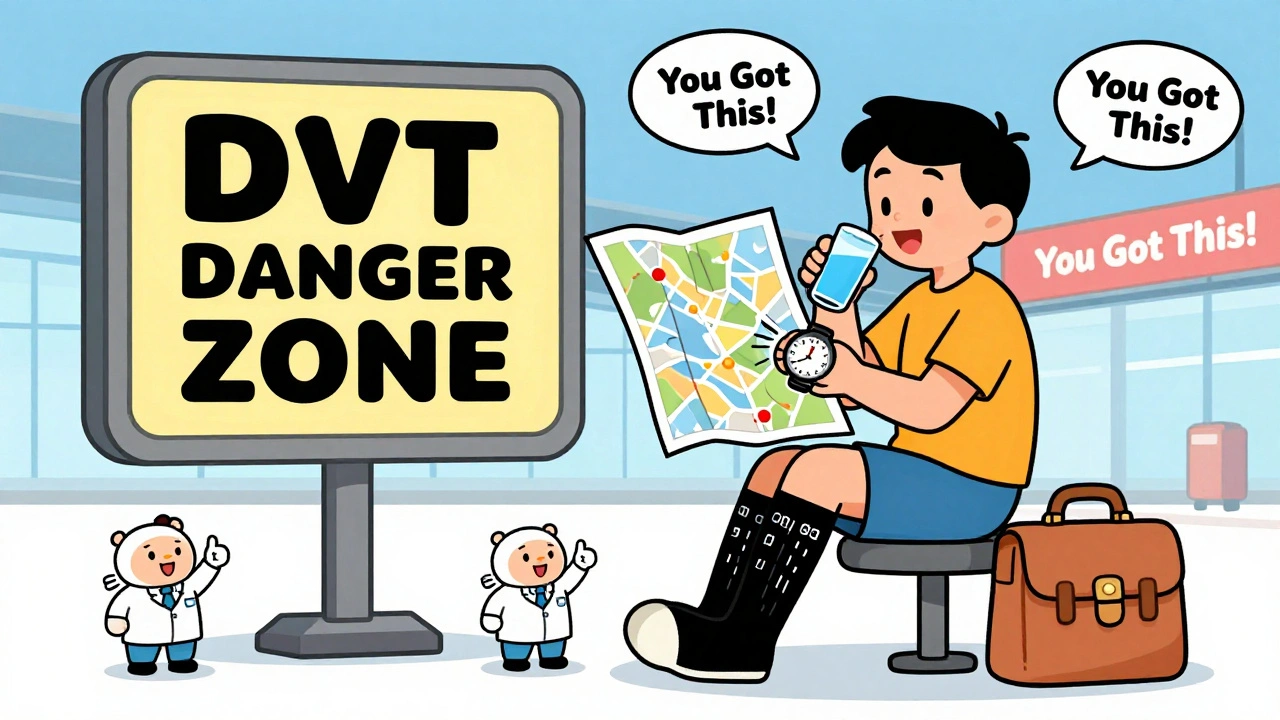
Pack your meds in your carry-on. Never check them. Airlines lose bags. Customs can delay shipments. Bring enough for your whole trip plus a few extra days. Keep a printed list of your medications: drug name, dose, and your doctor’s contact info. If you’re on warfarin, include your latest INR result. If you’re a high-risk traveler, ask your doctor about compression stockings. These aren’t fashion accessories-they’re medical devices. Look for below-knee graduated compression stockings with 15-30 mmHg pressure at the ankle. Wear them during travel. They squeeze your legs gently, pushing blood back toward your heart. For those on low molecular weight heparin (LMWH) like dalteparin, you’ll need to inject yourself before flying. But this isn’t ideal for long trips. The shots need refrigeration, and carrying needles through security can be messy. DOACs are easier-just swallow a pill. But they’re expensive: rivaroxaban costs about $575 for 30 tablets in the U.S., while warfarin is $4. If you’re traveling to a low-income country, check if your DOAC is available. Apixaban isn’t in 32% of them, according to WHO data.What to Do During Travel
Move every 30 minutes. Do seated calf raises: lift your heels while keeping toes on the floor, then lower. Do 10 reps every half-hour. Stand up and walk the aisle every 2-3 hours. If you’re driving, stop every 2 hours. Walk for 5 minutes. Stretch your legs. Don’t cross them. That squeezes veins and slows blood flow. Drink water. Avoid alcohol and sugary drinks. They dehydrate you, which thickens your blood. The CDC recommends at least 8 ounces of water every hour on a flight. Bring an empty bottle and fill it after security. Choose an aisle seat if possible. It makes getting up easier. If you’re in a window seat, ask to switch. Most airlines will let you change before boarding.Warning Signs: Know When to Act
Clots don’t always show up during travel. They can develop up to 8 weeks after you get home. Watch for:- Swelling, warmth, or pain in one leg (especially the calf)
- Chest pain that gets worse when you breathe
- Sudden shortness of breath
- Coughing up blood
Travel After a Recent Clot
If you’ve had a DVT or PE in the last 4 weeks, the advice isn’t clear-cut. Cambridge University Hospitals says wait at least 4 weeks. The International Air Transport Association (IATA) says you can fly as long as you’re asymptomatic and stable on anticoagulants. That’s a gap. Most doctors recommend waiting 2-4 weeks after diagnosis, especially if the clot was unprovoked or linked to cancer. If you’re cleared to travel, wear compression stockings, take your meds, and move often. Don’t rush. Your body is still healing.What’s Changing in the Future
Right now, there’s no universal rule for giving extra blood thinners before flights. Aspirin doesn’t help and can cause bleeding. Adding more anticoagulants isn’t recommended for most people. But research is changing. The MARVEL trial (NCT04585767), expected to finish in late 2024, is testing whether a single dose of rivaroxaban before a long flight helps high-risk travelers. If it works, we might soon have a standard protocol: “Take one pill before your flight if you’re high risk.” For now, the best advice is simple: stick to your meds, move often, drink water, and know the signs of trouble. You don’t need to avoid travel. You just need to be smart about it.Before You Go: Your Quick Checklist
- Get your INR checked (if on warfarin) 1-2 weeks before departure
- Bring extra medication + 3-5 extra days’ supply
- Carry a printed list of meds, doses, and doctor’s contact info
- Ask your doctor if compression stockings are right for you
- Confirm your DOAC is available at your destination
- Set phone alarms for medication times across time zones
- Know the nearest hospital or clinic at your destination
- Wear compression stockings during all long trips (4+ hours)
- Walk or stretch every 2-3 hours
- Drink water. No alcohol or soda.
Traveling on blood thinners isn’t about fear. It’s about control. You’ve already done the hard part-managing a chronic condition. Now you just need to bring that same discipline to your trip.

Steve Sullivan
December 9, 2025 AT 12:44Sabrina Thurn
December 10, 2025 AT 23:25Angela R. Cartes
December 11, 2025 AT 05:31Chris Marel
December 11, 2025 AT 23:46Tejas Bubane
December 12, 2025 AT 00:25Andrea DeWinter
December 12, 2025 AT 20:45Larry Lieberman
December 13, 2025 AT 08:43Courtney Black
December 15, 2025 AT 04:26George Taylor
December 17, 2025 AT 03:52Lisa Whitesel
December 17, 2025 AT 22:45Ajit Kumar Singh
December 18, 2025 AT 16:23Simran Chettiar
December 20, 2025 AT 00:23