
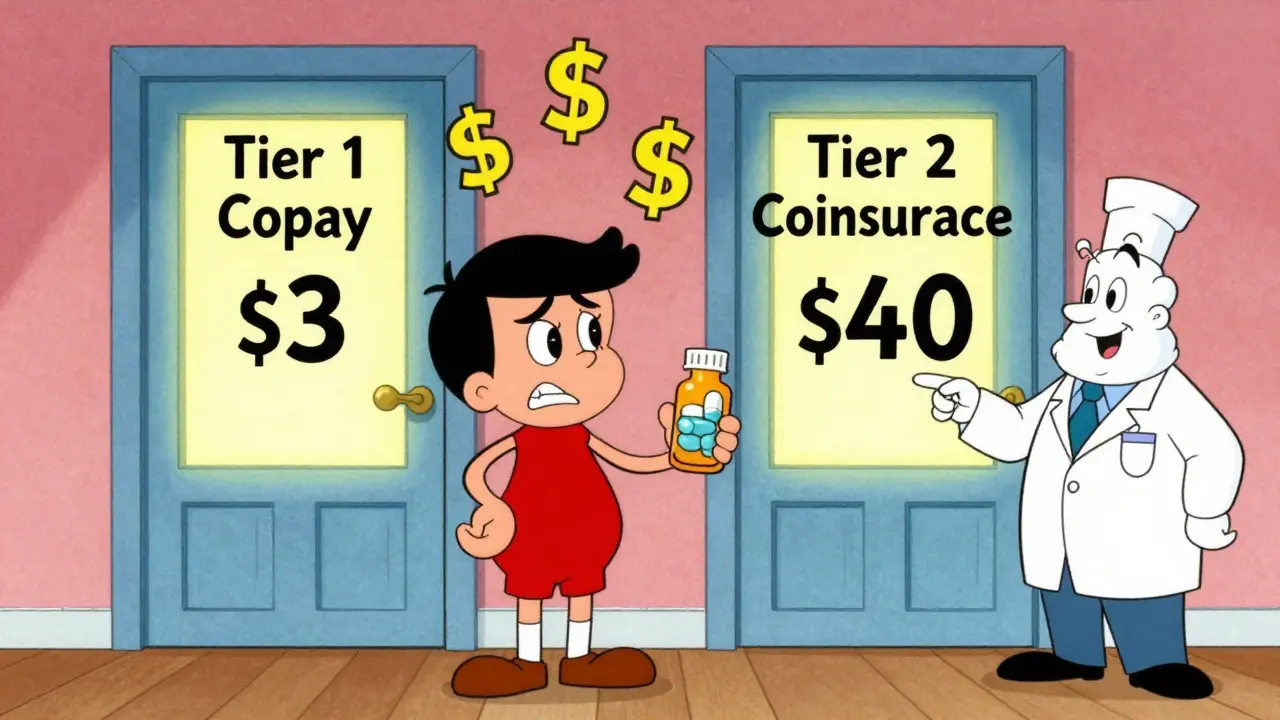
Why Generic Drug Coverage Matters More Than You Think
When you switch health plans, most people focus on monthly premiums or doctor networks. But one of the biggest hidden costs? Generic drug coverage. If you take even one regular medication - like metformin for diabetes, lisinopril for blood pressure, or levothyroxine for thyroid issues - your out-of-pocket costs can jump by hundreds or even thousands of dollars overnight. That’s not a typo. A plan with a $5 generic copay versus one with a $40 coinsurance can mean $800 extra per year in your pocket. And it’s not just about price. It’s about whether your exact brand of generic is even covered.
How Formularies Work: The Tier System Explained
Every health plan organizes drugs into tiers. Think of it like a pricing ladder. The lower the tier, the cheaper you pay. Most plans use 3 to 5 tiers. Here’s how it breaks down:
- Tier 1: Preferred Generics - These are the cheapest. Usually $3-$20 for a 30-day supply. Examples: generic metformin, generic atorvastatin.
- Tier 2: Non-Preferred Generics - Slightly more expensive. $20-$40. Often happens when your drug switches manufacturers or isn’t on the plan’s preferred list.
- Tier 3: Preferred Brand-Name Drugs - Higher cost, but still covered.
- Tier 4: Non-Preferred Brands - You pay a lot more. Sometimes 30% coinsurance.
- Tier 5: Specialty Drugs - Even some generics fall here if they’re complex (like injectables or high-dose versions). Coinsurance can hit 25-30%.
Here’s the catch: two drugs with the same active ingredient can be on different tiers. For example, one plan might cover Teva’s metformin in Tier 1 but put Mylan’s version in Tier 2. Same drug. Different price. That’s why checking the exact manufacturer matters.
How Deductibles Change Everything
Not all plans treat prescriptions the same way. Some combine your medical and drug deductible. Others separate them. And some don’t have a drug deductible at all.
Take Silver Standardized Plans (SPDs) on the Health Insurance Marketplace. These plans waive your deductible for Tier 1 generics. You pay a flat $20 copay - even if you haven’t met your $2,000 medical deductible. That’s huge. If you take three generics a month, you’re saving $1,200 a year compared to a non-SPD plan where you’d pay full price until you hit the deductible.
But if you’re on a High-Deductible Health Plan (HDHP) without SPD benefits? You could be paying $100+ per month out of pocket for your meds until you hit $3,000 or more in medical + drug costs. That’s not a bargain. That’s a trap.
Medicare Part D vs. Private Plans: What’s Different?
If you’re on Medicare, things get more complex. Part D plans have their own formularies, and they’re not always transparent. In 2023, the base deductible was $505 - but most plans had lower or no deductibles for generics. Many offered $0-$10 copays for Tier 1 generics.
Medicare Advantage plans (MA-PDs) that include drug coverage often save you more than standalone Part D plans. On average, beneficiaries pay 18% less out of pocket for generics with MA-PDs. But here’s the problem: plans change their formularies every year. A drug that was Tier 1 last year could be Tier 2 this year. And you won’t get a heads-up.
And don’t assume “generic” means “same cost.” One user switched plans and found their levothyroxine went from $0 to 25% coinsurance - even though both plans called it a “generic.” The difference? One plan only covered one manufacturer’s version.
State Rules Can Make or Break Your Costs
Where you live affects your drug costs more than you think.
- California: Has a $85 separate outpatient drug deductible. After that, you pay 20% coinsurance - capped at $250 per prescription.
- New York: Waives deductibles for generics entirely. You pay a flat $75 copay for specialty drugs, but $0 for Tier 1 generics.
- DC: Has a $350 separate drug deductible, but caps specialty drug costs at $150.
So if you’re moving from New York to California, your $3 generic copay could become a $85 deductible + 20% coinsurance. That’s a 5x increase. Always check your state’s prescription drug rules before switching plans.
What Most People Get Wrong (And How to Avoid It)
Here’s the reality: 68% of people switching plans don’t check if their exact generic version is covered. They assume “metformin is metformin.” It’s not.
Common mistakes:
- Not checking the manufacturer - your current pill might be off-formulary.
- Ignoring pharmacy networks - your local CVS might charge 300% more than a preferred pharmacy.
- Assuming mail-order = cheaper - sometimes it is, sometimes it’s not. Compare costs.
- Forgetting strength matters - 500mg metformin might be covered, but 1000mg isn’t.
One Reddit user switched plans and paid $180 for a 30-day supply of generic lisinopril - because their new plan didn’t cover the brand they were on. They had to switch to a different generic, which caused their blood pressure to spike. They ended up in the ER. That’s not an exaggeration. That’s a real case from 2023.
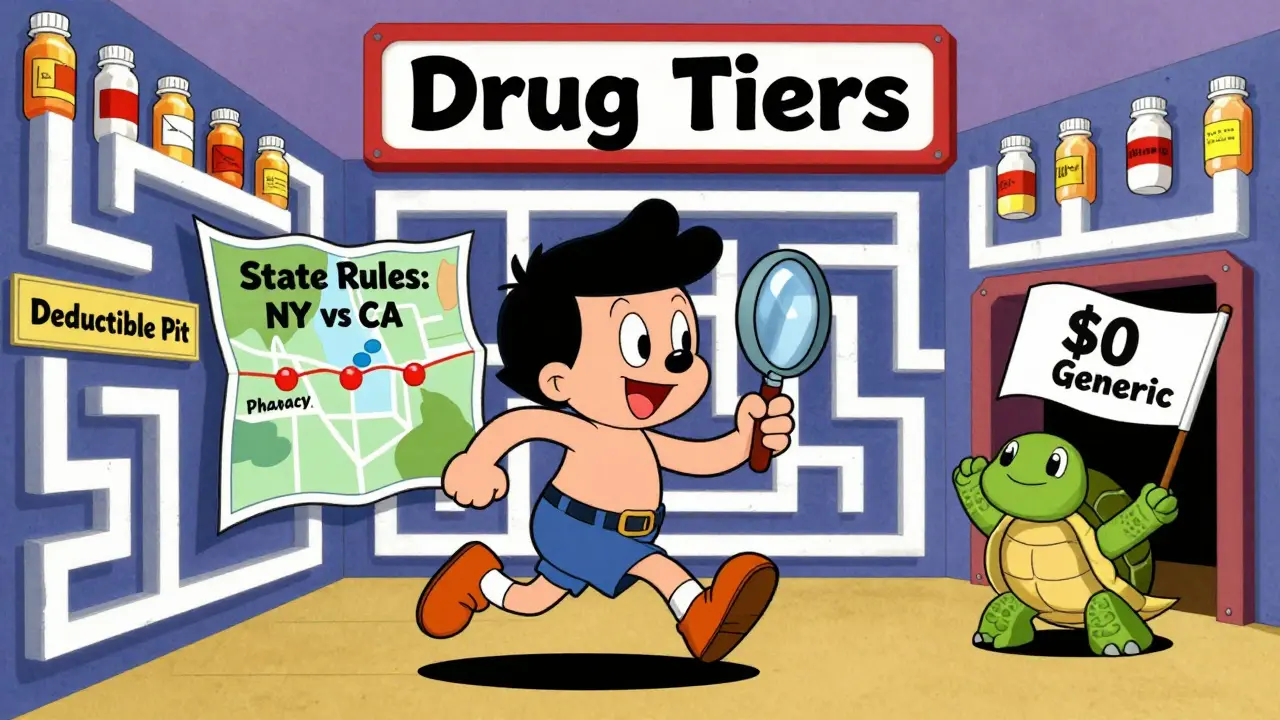
How to Check Your Plan’s Coverage - Step by Step
Don’t guess. Don’t rely on customer service alone. Do this:
- Get the full formulary - Not just a summary. Download the complete drug list from the insurer’s website.
- Search your exact drugs - Use the brand name and generic name. Include the manufacturer if you know it (check your pill bottle).
- Check the tier - Is it Tier 1? Tier 2? What’s the copay or coinsurance?
- Look up your pharmacy - Is your local pharmacy in-network? What’s the cost there versus mail-order?
- Calculate your annual cost - Multiply your monthly cost by 12. Add any deductible you’ll need to meet first.
Use tools like Medicare.gov’s Plan Finder or Healthcare.gov’s plan selector. They let you input your medications and compare total annual costs. In 2022, users who used these tools reduced prescription complaints by 37%.
What’s Changing in 2025 and Beyond
The rules are shifting. Starting in 2025, Medicare Part D will cap out-of-pocket drug costs at $2,000 per year. Insulin will still be capped at $35/month. But here’s the twist: generics are being split into more tiers. Some plans will now have Tier 1 (preferred generics) and Tier 1+ (non-preferred generics) - meaning even your “cheap” drug could suddenly cost more.
States are also stepping in. California, New York, and others are pushing for $0 insulin copays and tighter rules on pharmacy benefit managers (PBMs). By 2027, experts predict most marketplace plans will drop the combined medical-drug deductible. Why? Because people keep getting burned.
Final Tip: Don’t Wait Until Enrollment
If you’re thinking about switching plans - whether you’re on Medicare, an employer plan, or the marketplace - start checking formularies now. Don’t wait for open enrollment. Call your pharmacy. Ask them: “If I switched to Plan X, how much would my metformin cost?” They can often pull up formulary data faster than you can.
Generic drugs save the U.S. healthcare system over $300 billion a year. But those savings only matter if you’re on the right plan. A $3 copay isn’t just a number. It’s a choice. And if you don’t check, you’re choosing to pay more.
Chris & Kara Cutler
January 31, 2026 AT 16:18Rachel Liew
February 2, 2026 AT 12:07Melissa Melville
February 4, 2026 AT 08:12Bryan Coleman
February 4, 2026 AT 15:29franklin hillary
February 4, 2026 AT 21:31Ishmael brown
February 5, 2026 AT 18:32June Richards
February 7, 2026 AT 03:51Lu Gao
February 9, 2026 AT 01:11vivian papadatu
February 10, 2026 AT 18:36Deep Rank
February 11, 2026 AT 09:17Naresh L
February 12, 2026 AT 16:35Sami Sahil
February 13, 2026 AT 06:10