
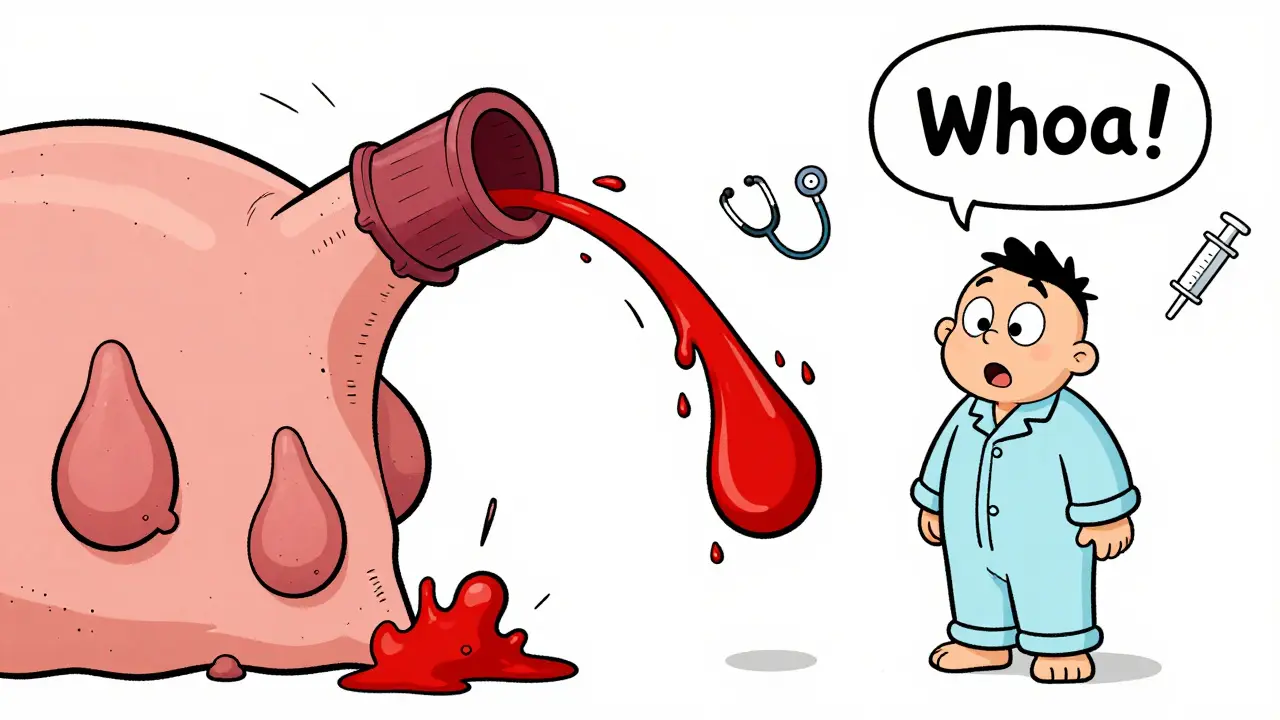
When you see bright red blood in your stool, it’s natural to panic. But not all lower GI bleeding is the same. Two of the most common causes-diverticula and angiodysplasia-look very different on the surface, even though they both lead to bleeding from the colon. One can dump a liter of blood in minutes. The other might slowly drain your iron stores over months, leaving you tired and weak without ever giving you a single bloody stool. Knowing the difference isn’t just academic-it changes how you’re treated, how long you stay in the hospital, and whether you’ll need surgery.
What Exactly Is Lower GI Bleeding?
Lower gastrointestinal bleeding means blood is coming from somewhere in your colon, rectum, or anus. It’s not the same as upper GI bleeding, which comes from the stomach or small intestine and usually turns stool black and tarry (melena). Lower GI bleeding shows up as hematochezia-bright red or maroon blood mixed in with stool or passed separately. It’s common in people over 60. About 20 to 27 out of every 100,000 adults experience it each year in the U.S., and the numbers are rising as the population ages.Most cases stop on their own. But when they don’t, the real challenge is figuring out why. Two conditions account for nearly half of all serious cases: diverticula and angiodysplasia. These aren’t rare quirks-they’re the leading culprits behind hospital admissions for GI bleeding.
Diverticula: The Silent Burst
Diverticula are small pouches that stick out from the wall of your colon. They form where the muscle layer is weak, usually in the sigmoid colon (the lower left side). Almost half of people over 60 have them. Most never cause problems. But in about 1 in 5, a blood vessel that runs along the outside of the pouch gets torn.This isn’t diverticulitis-there’s no infection or inflammation. It’s purely a vascular rupture. The vessel, called the vasa recta, runs right beneath the mucosa. When a diverticulum forms, the vessel gets pulled over the top of the pouch. It’s like a rubber band stretched too tight. A sudden pressure change-maybe from straining, lifting, or even just a hard bowel movement-can snap it.
The result? Massive, painless bleeding. Patients often describe it as "gushing" or "like a faucet turned on." Some lose over a liter of blood in minutes. They may feel dizzy, faint, or get chest pain from low blood pressure. But they don’t have abdominal pain. That’s a key clue: if you’re bleeding heavily and your belly feels fine, diverticula are likely the cause.
Good news: 80% of these bleeds stop without any treatment. Your body clots the vessel naturally. The rest need help-usually endoscopic therapy. Doctors use a scope to find the bleeding point, inject epinephrine to shrink the vessel, then apply heat or clips to seal it. Success rates are high-85 to 90% stop bleeding right away. But about 1 in 4 will bleed again within a year.
Angiodysplasia: The Slow Leak
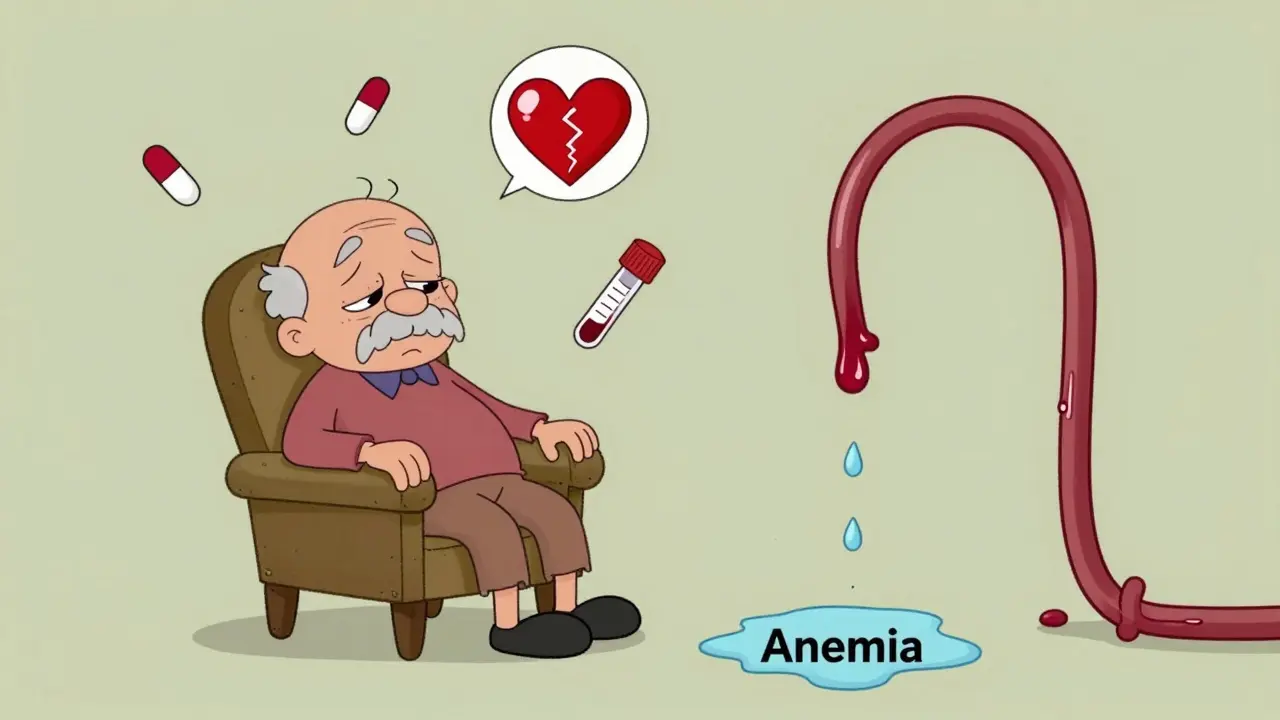
Angiodysplasia is a fancy term for abnormal blood vessels in the colon. They’re not tumors. They’re not infections. They’re just stretched-out, fragile capillaries that form tiny connections between arteries and veins-like a leaky garden hose that’s been twisted too many times. These are most common in the right side of the colon, especially the cecum.Why here? Because blood flow is higher in the right colon. As you age, the vessels lose elasticity. They dilate. Over time, they become so thin-walled that they bleed with every bowel movement. Unlike diverticula, this isn’t a sudden event. It’s a drip-feed. You might not even notice the blood. Instead, you feel tired. Your skin looks pale. Your heart races with minimal effort. Your doctor finds you’re anemic-hemoglobin below 10 g/dL-and wonders why.
Angiodysplasia is the second most common cause of major lower GI bleeding after diverticula. It’s rare under 50. After 70, it becomes much more common. Over 80% of cases occur in people over 65. The average age at diagnosis is 72.
Here’s a twist: angiodysplasia is sometimes linked to heart disease. If you have aortic stenosis-a narrowed heart valve-the turbulent blood flow can break down a clotting protein called von Willebrand factor. That makes you more likely to bleed from these fragile vessels. So if you’re an older patient with both heart valve disease and recurring anemia, your doctor should suspect angiodysplasia.
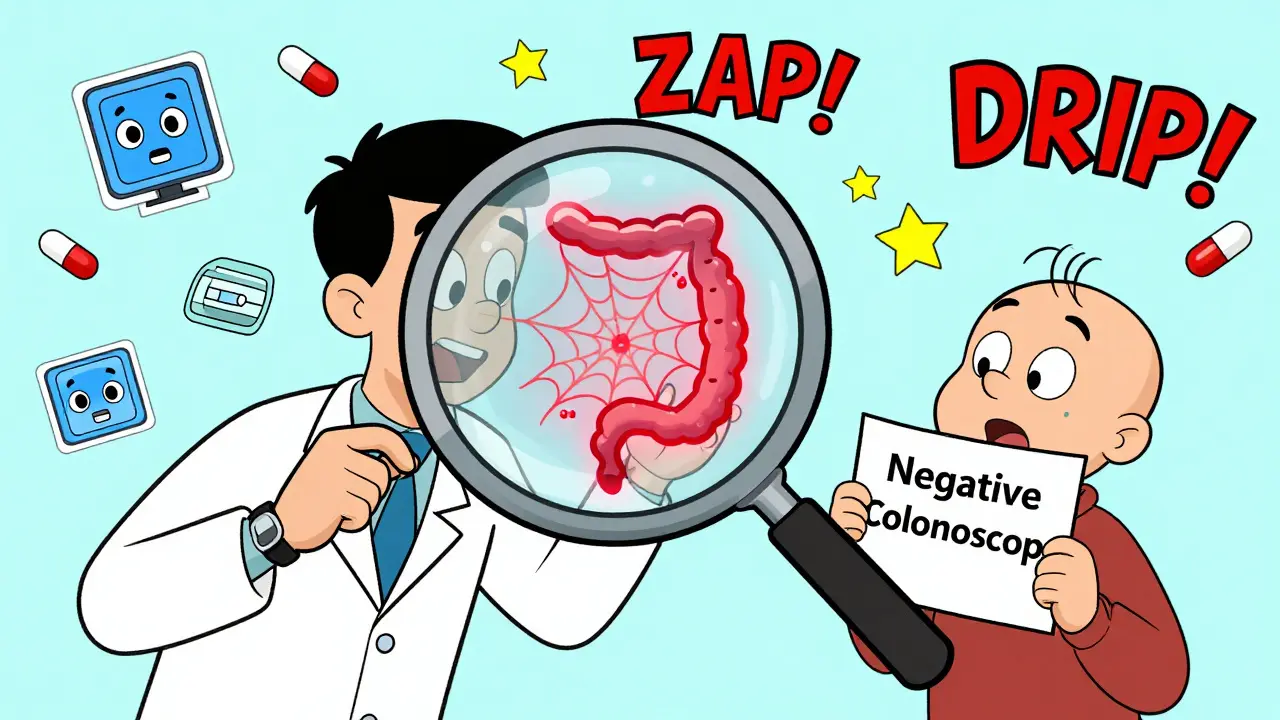
Diagnosing it is tricky. These lesions are small, flat, and often hidden under mucus. A standard colonoscopy can miss them. That’s why experts now use high-definition scopes with dye spraying or narrow-band imaging to highlight the red, spiderweb-like vessels. Even then, they’re easy to overlook.
The Workup: How Doctors Find the Source
When you arrive at the ER with GI bleeding, the first priority is stabilization. Are you dizzy? Is your heart racing? Is your blood pressure dropping? If yes, you get fluids, oxygen, and maybe a blood transfusion right away.Then comes the workup:
- Lab tests: CBC (to check hemoglobin), coagulation panel (to rule out clotting disorders), and type and crossmatch (in case you need blood).
- Colonoscopy: This is the gold standard. It’s done within 24 hours if you’re stable enough. Studies show early colonoscopy cuts death risk by 26%. Even if you’re bleeding, doctors can use IV fluids and erythromycin to clear the bowel fast. No need to wait for perfect prep.
- CT angiography: If colonoscopy doesn’t find the source, and you’re still bleeding, a CT scan with contrast can pinpoint active bleeding at rates as low as 0.5 mL per minute. It’s fast, non-invasive, and great for emergencies.
- Capsule endoscopy or enteroscopy: If the bleeding keeps coming back and colonoscopy was clean, they’ll look higher up-into the small bowel. Capsule endoscopy (a pill-sized camera) finds the cause in 62% of cases. But it can get stuck in narrowed areas. Device-assisted enteroscopy (a longer scope with balloons) finds 71% of cases but requires more skill and time.
One big mistake? Assuming every anemic elderly patient has angiodysplasia. Many have incidental vascular changes that aren’t bleeding. A 2022 Harvard Health review warned that up to 40% of these "findings" are red herrings. Only treat if there’s clear evidence of active bleeding.
Treatment: What Works and What Doesn’t
| Feature | Diverticula Bleeding | Angiodysplasia Bleeding |
|---|---|---|
| Typical Presentation | Sudden, massive, painless hematochezia | Chronic, intermittent, low-volume bleeding; anemia without visible blood |
| Spontaneous Stopping Rate | 80% | 50-60% |
| First-Line Endoscopic Therapy | Epinephrine + thermal coagulation | Argon plasma coagulation (APC) |
| Immediate Hemostasis Rate | 85-90% | 80-90% |
| Rebleeding Rate (1-2 years) | 20-30% | 20-40% |
| Medical Therapy for Recurrence | Not routinely used | Thalidomide (100 mg/day), Octreotide |
| Surgical Option | Segmental colectomy (if localized) | Right hemicolectomy (for cecal lesions) |
For diverticula, the goal is to stop the current bleed and prevent recurrence. Surgery is rarely needed unless bleeding keeps coming from the same spot. For angiodysplasia, the problem is recurrence. Even after successful APC, up to 40% will bleed again within two years.
That’s where newer drugs come in. Thalidomide, once known for birth defects, has shown surprising promise. A 2019 study in Gut found that 100 mg daily reduced transfusion needs by 70% in patients with recurrent angiodysplasia. Octreotide, a hormone that narrows blood vessels, works in about 60% of cases when given as daily injections. Both are used off-label but are now part of standard protocols at major centers.
And there’s new tech. AI-assisted colonoscopy systems now flag angiodysplasia lesions in real time, boosting detection by 35%. New endoscopic clips are also proving more effective than heat for sealing diverticular bleeds-92% success in a 2023 European trial.
What Happens After the Bleed?
Your prognosis depends less on the bleeding itself and more on your other health problems. About 10-22% of people with diverticular bleeding die within 30 days-but not because of the bleed. It’s usually heart failure, kidney disease, or infection. For angiodysplasia, mortality is lower (5-10%), but quality of life suffers. Patients often endure multiple hospital stays, iron infusions, and endless colonoscopies.One patient from the Inspire GI community said: "I had five negative colonoscopies before they finally found the lesion. I thought I was being ignored. I felt like a broken machine." That’s not uncommon. The average time from first symptom to diagnosis for angiodysplasia is 18 months.
For diverticula, most people never bleed again. But if you’ve had one episode, you’re at higher risk. Avoid heavy lifting. Stay well-hydrated. Eat fiber-not just for constipation, but to reduce pressure in the colon. No need for routine repeat colonoscopies unless you have other risk factors like polyps or family history of colon cancer.
When to Worry
Not every speck of blood means disaster. But if you’re over 60 and notice:- Sudden, large amounts of bright red blood
- Unexplained fatigue, dizziness, or shortness of breath
- Repeated episodes of anemia without a clear cause
-get checked. Don’t wait. Don’t assume it’s hemorrhoids. Don’t brush it off as "just aging." The tools to find and fix these problems exist. And they work.
Right now, the NIH is running a phase III trial comparing thalidomide to placebo for recurrent angiodysplasia. Results are due in late 2024. That means better treatments are coming. But for now, the key is early diagnosis-and knowing when to ask for the right test.
Can diverticula bleed without causing pain?
Yes. Diverticular bleeding is typically painless because it’s caused by a ruptured blood vessel, not inflammation. Pain would suggest diverticulitis, which is a different condition involving infection. If you’re bleeding heavily and your abdomen feels fine, diverticula are the likely culprit.
Is angiodysplasia the same as a tumor?
No. Angiodysplasia is not a tumor. It’s a vascular malformation-a cluster of fragile, dilated blood vessels that form tiny connections between arteries and veins. These aren’t cancerous growths. They’re structural weaknesses in the vessel walls, often caused by aging or heart valve disease.
Why does colonoscopy sometimes miss angiodysplasia?
Angiodysplasia lesions are small, flat, and often hidden under mucus or stool. Standard colonoscopy can overlook them, especially if the bowel prep wasn’t perfect or the scope isn’t high-definition. Special techniques like narrow-band imaging or dye spraying improve detection. AI-assisted systems now help flag these lesions in real time.
Can I prevent diverticula from bleeding?
You can’t prevent diverticula from forming, but you can reduce your risk of bleeding. Eat a high-fiber diet to avoid constipation and straining. Stay hydrated. Avoid heavy lifting and sudden physical strain. Some studies suggest aspirin and NSAIDs may increase bleeding risk, so talk to your doctor before taking them regularly.
Do I need surgery if I have angiodysplasia?
Surgery is rarely needed. Most cases respond to endoscopic treatment like argon plasma coagulation. Surgery (right hemicolectomy) is only considered if bleeding keeps coming back from the same spot despite multiple endoscopic attempts, or if the lesion is in the cecum and you’re a good surgical candidate.
Is thalidomide safe for treating recurrent bleeding?
Thalidomide is used off-label for this purpose and is generally safe in older adults when monitored. It can cause drowsiness, nerve damage, and birth defects-so it’s not used in women who could become pregnant. Blood tests and neurological checks are required. But for patients with frequent, disabling bleeding, the benefits often outweigh the risks.
What Comes Next?
If you’ve had one episode of lower GI bleeding, you’re now in a higher-risk group. Follow up with your gastroenterologist. Ask if you need repeat colonoscopy. If you’re anemic, get iron levels checked-not just hemoglobin. If you have heart disease, mention it. Angiodysplasia doesn’t show up on every test. But if you’ve had three negative scopes and still feel weak, push for capsule endoscopy or CT angiography.The good news? Most people recover fully. With modern tools, we can find these hidden bleeds. We can stop them. And we’re getting better at preventing them from coming back. You don’t have to live with fatigue or fear. You just need to speak up-and get the right test at the right time.
Christine Joy Chicano
January 8, 2026 AT 08:01Wow. This is one of those posts that makes you realize medicine isn’t just science-it’s storytelling. The way they described diverticula bleeding as 'like a faucet turned on'-chills. And angiodysplasia being a slow drip that steals your energy without warning? That’s not just clinical, that’s poetic. Someone should turn this into a TED Talk.
Also, thalidomide? For real? The same drug that caused those tragedies in the 50s is now helping old folks stop bleeding? History has a weird way of circling back.
And AI flagging lesions in real time? I didn’t even know that was a thing. This post just upgraded my entire view of modern gastroenterology.
LALITA KUDIYA
January 9, 2026 AT 12:33So much info 😍 thank you for sharing! I’m from India and we don’t talk about this enough. My uncle had this and no one knew what was happening. Now I know what to ask the doctor. 🙏
Poppy Newman
January 11, 2026 AT 05:01Angiodysplasia = colon’s version of a leaky garden hose 🌱💧 I’m literally visualizing this now. Also, why is no one talking about how terrifying it is to have five negative colonoscopies and still feel like you’re dying? That patient quote broke me.
Also, thalidomide? Wild. 🤯
Alex Danner
January 11, 2026 AT 17:41Correcting a common misconception: people think colonoscopy prep is just about cleanliness. It’s not. It’s about timing. Erythromycin speeds up gastric emptying, so even if your prep isn’t perfect, you can still get a clean view in under an hour. That’s why early colonoscopy works-it’s not magic, it’s pharmacology.
Also, CT angiography at 0.5 mL/min? That’s like detecting a dripping faucet from a mile away. The tech we have now is insane.
And yes-thalidomide is off-label but it’s in the guidelines now. The Gut study was a game-changer. No more just iron infusions and hoping it stops.
Andrew N
January 11, 2026 AT 19:21Diverticula bleed? Yeah, sure. But most people who get this are just fat and don’t eat fiber. It’s not complicated. Stop making it sound like a mystery. Just eat more broccoli and stop lifting weights. Done.
Also, thalidomide? That’s a drug for babies with birth defects. Why are you giving it to old people? Sounds like a scam.
Anastasia Novak
January 12, 2026 AT 11:21Oh my god. I’m crying. Not because I’m moved-because I’ve been this patient. I had three colonoscopies. Three. And they all said ‘nothing.’ Meanwhile I was turning into a ghost. Pale. Weak. Heart racing when I walked to the fridge.
Then my sister-bless her-said ‘what if it’s not cancer?’ and made me push for a capsule endoscopy. Found it. Two lesions. APC. Done.
But here’s the real tragedy: I waited 22 months. That’s not medical negligence. That’s systemic failure. And now I’m supposed to be grateful they ‘finally’ found it?
Also, thalidomide? I’m on it. I sleep like a baby now. But I’m terrified the FDA will yank it tomorrow because someone’s cousin got a rash.
Stop treating elderly bleeding like a footnote.
Emma Addison Thomas
January 13, 2026 AT 07:04I’m from London and I’ve seen so many older patients dismissed as ‘just getting old.’ This post should be mandatory reading for every GP in the NHS. It’s not about being dramatic-it’s about recognizing that bleeding doesn’t always look like what we expect.
My mum had chronic anemia for a year. They gave her iron pills. She got worse. Then she collapsed. Turned out it was angiodysplasia. No pain. No warning. Just exhaustion.
Thank you for writing this. It’s the kind of thing that saves lives when it’s shared.
Katrina Morris
January 14, 2026 AT 17:49i had this happen to my dad last year and no one knew what was going on until he passed out in the kitchen 😭 we thought it was just low iron but then the doc said 'you lost a liter in 3 minutes' and i was like WHAT
thank you for explaining the difference between diverticula and angio so clearly i finally get it now
also thalidomide?? wow i didnt know that was even a thing anymore
Vince Nairn
January 16, 2026 AT 01:20So let me get this straight-you’re telling me the medical community has been missing these lesions for decades because they’re too lazy to use fancy scopes?
And now we’re using AI to do the work we should’ve done with basic training?
Classic. We’re out here inventing drones to find lost keys while the flashlight’s been in our pocket the whole time.
Also, thalidomide? Sounds like a plot twist from a medical drama. I’m here for it.
Jonathan Larson
January 16, 2026 AT 02:32There is a profound philosophical dimension to this clinical reality: the human body does not announce its failures with fanfare. Diverticula bleed with silent violence; angiodysplasia erodes dignity in slow, invisible increments. We treat symptoms, not the silence beneath them.
Modern medicine excels at intervention-but falters in detection. We have the tools to see the leaky hose, yet we wait for the flood before we look.
Perhaps the real crisis is not the bleeding-but our collective unwillingness to see what is not screaming.
Thank you for illuminating this quiet epidemic.
Adam Gainski
January 17, 2026 AT 16:12Just to clarify one thing-when we say '80% of diverticular bleeds stop on their own,' that doesn’t mean you should ignore it. It means you can survive the ride to the ER without a transfusion. But if you wait too long, you’re still at risk for rebleeding or complications.
Also, the reason we use epinephrine + thermal for diverticula but APC for angiodysplasia? It’s about vessel size. Diverticula bleed from larger arteries; angiodysplasia is capillary-level. You need a finer tool.
And yes, AI detection is real. I’ve seen it catch lesions my attending missed. It’s not perfect, but it’s a game-changer.
Bottom line: if you’re over 60 and anemic, push for more than iron pills. Ask for a scope. Ask for a CT angiogram. Be the patient who won’t take 'nothing found' for an answer.
Ayodeji Williams
January 18, 2026 AT 22:26Bro this is wild but why is everyone acting like this is new? In Nigeria we’ve been seeing this for years but no one has the money for colonoscopy or APC. We just give them iron and hope they don’t die. Also thalidomide? We don’t even have that here. 😔
Y’all talk like this is a tech revolution but for most of the world it’s just a death sentence waiting to be diagnosed.
Kyle King
January 19, 2026 AT 02:50ALERT. ALERT. This post is sponsored by the GI industry. They want you to think you need expensive scopes, AI, and thalidomide. But what if it’s just your diet? What if it’s gluten? What if it’s 5G causing microvascular damage? Why are they not talking about that?
Also, why are they using a drug that was banned for babies? Sounds like a cover-up to me. I’ve seen this before. They hide the truth behind fancy words.
Just eat more kale. And pray.
Anthony Capunong
January 19, 2026 AT 07:11This is why America’s healthcare system is broken. You need a PhD to understand why you’re bleeding. Meanwhile, people in other countries just get a shot and go home. Why do we turn every simple problem into a 12-part Netflix documentary?
Also, thalidomide? That’s not medicine, that’s science fiction. We should be focusing on real solutions, not sci-fi drugs from the 1950s.
And why are we using AI? Is the doctor not good enough anymore? This is just corporate greed dressed up as innovation.
Mina Murray
January 19, 2026 AT 12:01So… you’re telling me the real reason we’re not finding these bleeds is because the colonoscopists are just lazy? And now they’re using AI to cover it up?
And thalidomide? That’s not a treatment-that’s a trap. The pharmaceutical companies are testing it on elderly people because they won’t sue. This is a human experiment.
Also, why is this post so detailed? Too detailed. Too many studies. Too many numbers. It smells like a drug rep wrote this.
My cousin’s neighbor’s cousin had this and they just gave him a blood transfusion. He’s fine now. No AI. No thalidomide. No drama.