
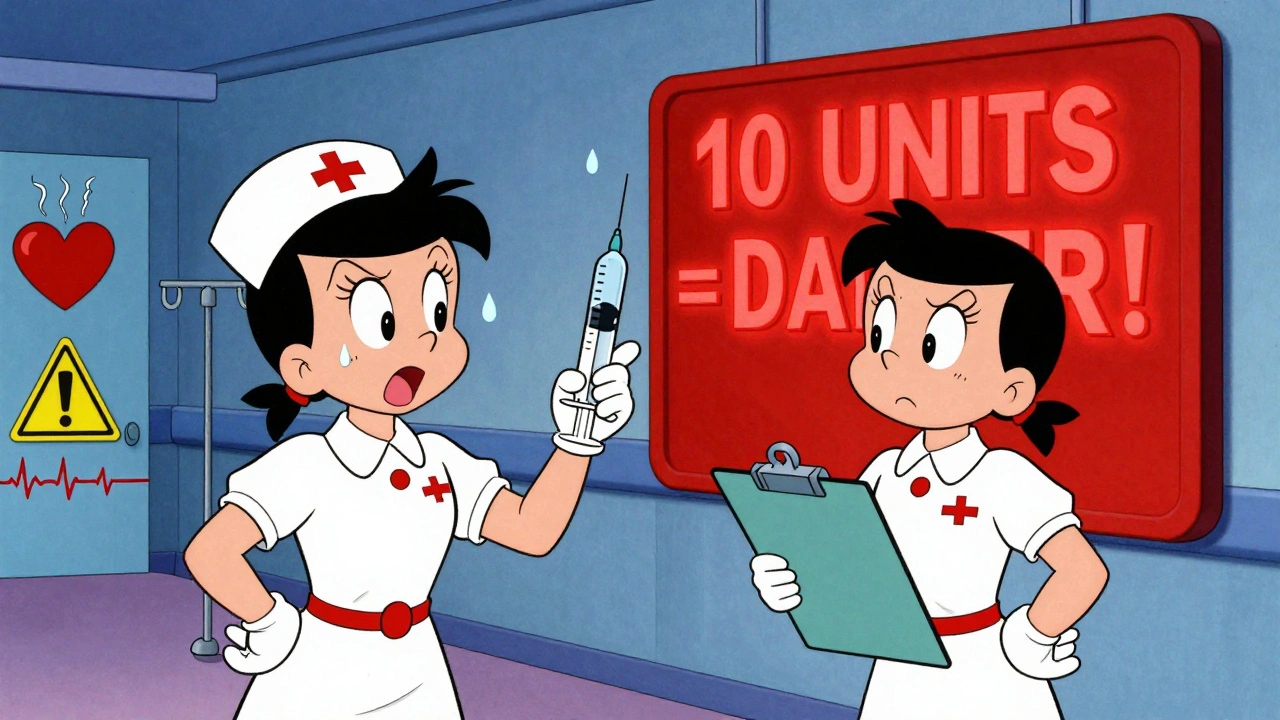
When a nurse hands a patient a vial of IV insulin, the stakes aren’t just high-they’re life or death. One misplaced decimal, one wrong syringe, one missed double check, and a patient can slip into a diabetic coma within minutes. This isn’t hypothetical. In Australian hospitals alone, over 200 preventable deaths each year are linked to medication errors, and nearly half involve high-risk drugs. That’s why extra verification procedures aren’t optional-they’re the last line of defense between a patient and catastrophe.
What Makes a Medication High-Risk?
Not all medications are created equal when it comes to danger. The Institute for Safe Medication Practices (ISMP) defines high-alert medications as those that carry a heightened risk of causing serious harm if used incorrectly-even if they’re used as intended. These aren’t rare or experimental drugs. They’re common, widely prescribed, and often taken for granted.- IV insulin: A single typo in the dose can trigger severe hypoglycemia. A 10-unit error isn’t a mistake-it’s a medical emergency.
- IV heparin: Used to prevent clots, but too much causes uncontrolled bleeding. Too little, and the patient risks stroke or pulmonary embolism.
- IV opioids: Fentanyl, morphine, hydromorphone-these drugs suppress breathing. A small overdose can stop someone’s heart.
- Chemotherapy agents: These are toxic by design. An incorrect dose doesn’t just fail to treat cancer-it can kill healthy cells faster than the disease.
- Potassium chloride concentrate: A concentrated form of potassium. If given too fast or in the wrong IV fluid, it causes cardiac arrest.
The Double Check: How It’s Supposed to Work
The gold standard for safety is the independent double check (IDC). Two qualified healthcare professionals independently verify every critical detail before the drug reaches the patient. This isn’t a formality. It’s a structured, step-by-step process designed to catch mistakes that one person might miss. Here’s how it works in practice:- First checker: Prepares the medication. Checks the prescription, calculates the dose, draws up the drug, labels the syringe, and prepares the IV line.
- Second checker: Does not watch the first person. They start from scratch-review the order, recalculate the dose, inspect the vial, verify the patient’s ID, confirm the route and rate.
- Both agree: Only when both independently confirm all nine rights-right patient, drug, dose, route, time, documentation, reason, response, and right to refuse-does the medication proceed.
- Both sign: Documentation is completed on the Medication Administration Record (MAR) with both signatures. No signature? No administration.
Who Can Perform a Double Check?
Not just anyone can be the second checker. The person must be qualified, trained, and authorized. In most hospitals, only:- Registered nurses
- Pharmacists
- Physicians or nurse practitioners
Where Double Checks Are Mandatory
The Joint Commission, Australia’s AHPRA, and the Department of Veterans Affairs all require institutions to create and enforce lists of high-alert medications. But the list isn’t universal. Each hospital builds its own based on:- Which drugs they use most
- What errors have happened there before
- What’s reported by manufacturers
- What’s flagged by ISMP and ECRI
The Problem with Overusing Double Checks
Here’s the uncomfortable truth: double checks aren’t magic. They can create a false sense of security. A 2022 ISMP survey found that 68% of nurses admitted skipping double checks during busy shifts. Why? Because they didn’t have time-or worse, there was no second person available. Forty-two percent said they simply couldn’t find someone to verify. And when double checks are done poorly, they’re worse than useless. If the second person just nods along because they trust the first, or if they’re rushing, they miss the same error. That’s called confirmation bias. It’s not negligence-it’s human nature. That’s why experts now say: less is more. Instead of double-checking every high-alert drug in every setting, focus on the highest-risk moments:- IV insulin infusions
- Chemotherapy preparation
- IV heparin boluses
- Epinephrine in neonates
- Calcium chloride or potassium chloride infusions
Technology Is Changing the Game
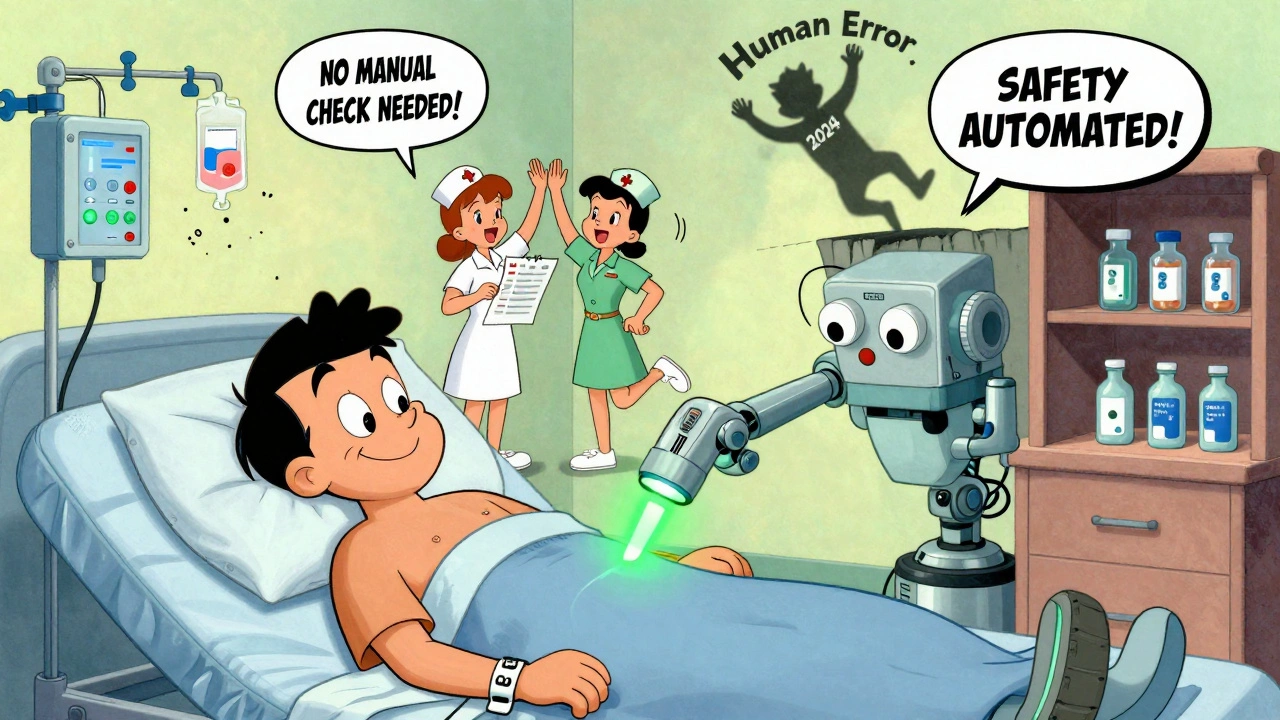
Barcode scanning, smart infusion pumps, and electronic prescribing are quietly reducing the need for manual double checks. - A barcode scan at the bedside confirms the right patient, right drug, right dose, and right time-all in three seconds. If the system flags a mismatch, it stops the process before the drug is drawn. - Smart pumps can be programmed with drug libraries. If you try to set an IV insulin rate of 100 units/hour, the pump will beep, lock, and alert the nurse. It won’t let you proceed. - Automated dispensing cabinets now require two-factor authentication for high-risk drugs. You can’t grab fentanyl without a PIN and a biometric scan. These tools don’t replace human judgment-they support it. They catch the obvious errors so staff can focus on the complex ones: interpreting lab values, recognizing early signs of toxicity, adjusting doses for kidney failure. The Department of Veterans Affairs in the U.S. is phasing out manual double checks for most drugs by 2024, replacing them with barcode and smart pump systems. Australia’s public hospitals are following suit, but slowly. Budgets, training gaps, and legacy systems hold back progress.What’s the Future of Medication Safety?
The future isn’t about doing more checks. It’s about doing smarter ones.- Target verification only where the risk is highest.
- Use technology to eliminate routine errors.
- Train staff not just on how to check, but why it matters.
- Design workflows so the safe choice is the easy choice.
What You Can Do
If you’re a patient or family member:- Ask: "Is this a high-risk medication?"
- Ask: "Will two staff members check it before I get it?"
- Ask: "Can I see the labels and the calculations?"
- Never skip the second check-even if you’re tired.
- Never let someone "watch" you do the check. Do it independently.
- Speak up if your system doesn’t support safe practices.
What are the most common high-alert medications that need double verification?
The most common high-alert medications requiring double verification include IV insulin, IV heparin, IV opioids (like fentanyl and morphine), chemotherapy agents, and concentrated potassium chloride. These drugs have narrow safety margins-small errors can cause death. Other high-risk medications include calcium chloride, epinephrine (especially in neonates), and certain antiarrhythmics like amiodarone.
Do all hospitals require double checks for these medications?
No. While organizations like The Joint Commission and ISMP strongly recommend double checks for high-alert medications, each hospital creates its own policy based on local risk data. Some hospitals apply double checks to all high-risk drugs, while others focus only on the most dangerous ones like IV insulin and chemotherapy. Smaller or under-resourced facilities may struggle to implement them consistently due to staffing shortages.
Can a nurse do the double check alone?
No. A true independent double check requires two separate individuals who verify the medication independently-without influencing each other. One person preparing the drug and another just watching isn’t enough. The second person must recalculate the dose, review the order, and confirm the patient’s identity without seeing the first person’s work. This prevents confirmation bias and catches hidden errors.
Why are barcode scanners replacing manual double checks?
Barcode scanning automatically matches the right drug, dose, patient, and time-without relying on human memory or attention. It’s faster, more accurate, and less prone to bias. While manual checks are still needed for complex preparations (like chemotherapy mixing), barcode systems eliminate the most common errors: wrong patient, wrong drug, wrong dose. Many hospitals are now using both: barcode for routine verification and manual checks only for the highest-risk scenarios.
What happens if a double check is skipped?
Skipping a double check is a serious breach of safety protocol. It doesn’t automatically mean harm will occur-but it removes a critical safety layer. Most hospitals treat this as a near-miss incident. The staff member is usually counseled, and the event is logged for review. Repeated violations can lead to retraining, suspension, or even disciplinary action. More importantly, it puts patients at risk. One skipped check could be the one that causes a preventable death.
Are double checks effective in preventing errors?
Yes-but only when done correctly. Studies show that properly executed independent double checks can reduce errors by up to 85% for high-risk medications. However, when done poorly-rushed, done by the same person, or skipped under pressure-they offer little to no protection. The key isn’t doing more checks. It’s doing fewer, smarter checks at the most dangerous points in the process.
Emma Sbarge
December 13, 2025 AT 17:13Let’s be real-double checks are a joke when you’re short-staffed and running on caffeine and guilt. I’ve had to rush through insulin verifications because the pharmacy was slow and the floor was screaming for help. It’s not that we don’t care-it’s that the system is designed to fail.
Scott Butler
December 14, 2025 AT 05:47Of course Americans are still doing manual checks. In Europe, they’ve had smart pumps and AI alerts for years. We’re still stuck in the 2000s because nobody wants to spend money on safety-until someone dies. Then it’s ‘oh no, we need a committee.’ Pathetic.
Ronan Lansbury
December 15, 2025 AT 10:50Did you know the WHO secretly funds pharmaceutical companies to keep manual checks alive? It’s all about control. If you automate verification, nurses become obsolete. And if nurses become obsolete, who’s left to blame when things go wrong? The algorithm, of course. The real danger isn’t insulin-it’s the surveillance state masquerading as healthcare.
Jennifer Taylor
December 15, 2025 AT 21:20Okay but like… have you seen the videos? Nurses crying in supply closets because they’re forced to choose between checking potassium for a dying patient or answering a code blue on the other side of the hospital? This isn’t policy-it’s torture. And they wonder why we burn out. 😭
Rawlson King
December 16, 2025 AT 06:13You people are missing the point. The real issue isn’t the drugs-it’s the culture. You treat nurses like disposable widgets and then act shocked when they make mistakes. If you want safety, stop punishing people for speaking up and start rewarding systems that work.
Michael Gardner
December 17, 2025 AT 14:54Actually, the data shows that double checks don’t reduce errors much at all. A 2023 JAMA study found no statistically significant improvement in error rates when double checks were mandated. The real win is barcode scanning. Stop romanticizing human checks-they’re just theater.
Willie Onst
December 19, 2025 AT 01:11I’ve been a nurse for 22 years and I’ll tell you this: the double check saved my patient’s life once. Not because we caught a typo-but because the second nurse noticed the patient’s face was turning gray before we even touched the syringe. Tech doesn’t see that. People do. Let’s not throw out the baby with the bathwater.
Shelby Ume
December 19, 2025 AT 14:40As a nurse educator, I train new grads on the independent double check. We role-play scenarios where the first nurse deliberately makes an error. The second nurse must catch it without being told. It’s brutal. But it works. And yes-it’s exhausting. But if you’re not willing to be the second set of eyes, you shouldn’t be in this job.
Jade Hovet
December 20, 2025 AT 16:40OMG YES!! I just had a moment yesterday where my partner was checking a heparin dose and I was like ‘wait-did you check the concentration??’ and she was like ‘oh no I didn’t’ and we almost gave 10x the dose 😱 thank god for that second brain!! 💪❤️
John Fred
December 21, 2025 AT 03:34Smart pumps are great, but they’re only as good as their drug libraries. If your institution hasn’t updated their library since 2019, you’re still vulnerable to dosing errors. And don’t get me started on off-label uses-those aren’t in the system. Tech helps, but it doesn’t replace clinical judgment.
Harriet Wollaston
December 22, 2025 AT 00:34My grandma almost died from a potassium error in a rural ER. They didn’t have a second nurse. They didn’t have a barcode scanner. They had a tired tech and a handwritten order. I’m so grateful someone wrote this. Patients need to ask questions. We’re not being nosy-we’re the last line of defense.
Hamza Laassili
December 23, 2025 AT 23:58Double checks? HA! They’re a scam. The real problem is the FDA allowing concentrated potassium to be sold in vials that look like saline. That’s not negligence-it’s corporate malice. And don’t even get me started on how the DEA pushes opioids while blocking safer alternatives!!
Lara Tobin
December 24, 2025 AT 04:17I just want to say thank you to every nurse who does the double check even when they’re exhausted. I see you. I know it’s hard. And I know you’re scared you’ll mess up. You’re not alone.
Donna Hammond
December 26, 2025 AT 04:01One sentence: The most effective safety protocol is not the double check-it’s the culture that empowers every staff member to stop the line without fear. When a tech says ‘I’m not comfortable,’ and the nurse listens-that’s when lives are saved.