

Immunosuppressant Hair Loss Risk Calculator
Select Your Medication
Hair Loss Risk Assessment
Select a medication to see your hair loss risk
Recommended Treatment Options
Important: Never stop your immunosuppressant without consulting your doctor. Hair loss is usually reversible with proper treatment.
When you're taking immunosuppressants to save your life-whether after a transplant or to control a serious autoimmune disease-hair loss shouldn't be the unexpected price you pay. But for many, it is. Around 10 to 15% of people on these medications notice their hair thinning or falling out, often months after starting treatment. It’s not just cosmetic. For some, it’s enough to make them question whether the medication is worth it.
Why Do Immunosuppressants Cause Hair Loss?
Not all immunosuppressants act the same way when it comes to hair. The main culprit is tacrolimus, a drug used in over 90% of kidney transplants. Studies show nearly 29% of kidney-pancreas transplant recipients on tacrolimus develop noticeable hair loss, especially women. In one study, 11 out of 13 people affected were female. That’s not a coincidence.
The problem isn’t that the drug kills hair follicles. Instead, it pushes them into resting mode too early. This is called telogen effluvium. Normally, hair grows for years (anagen phase), then rests for a few months before falling out. Immunosuppressants like tacrolimus and methotrexate interrupt the growth phase, forcing more follicles into the resting stage at once. The result? You shed more hair than usual-often 3 to 6 months after starting the drug.
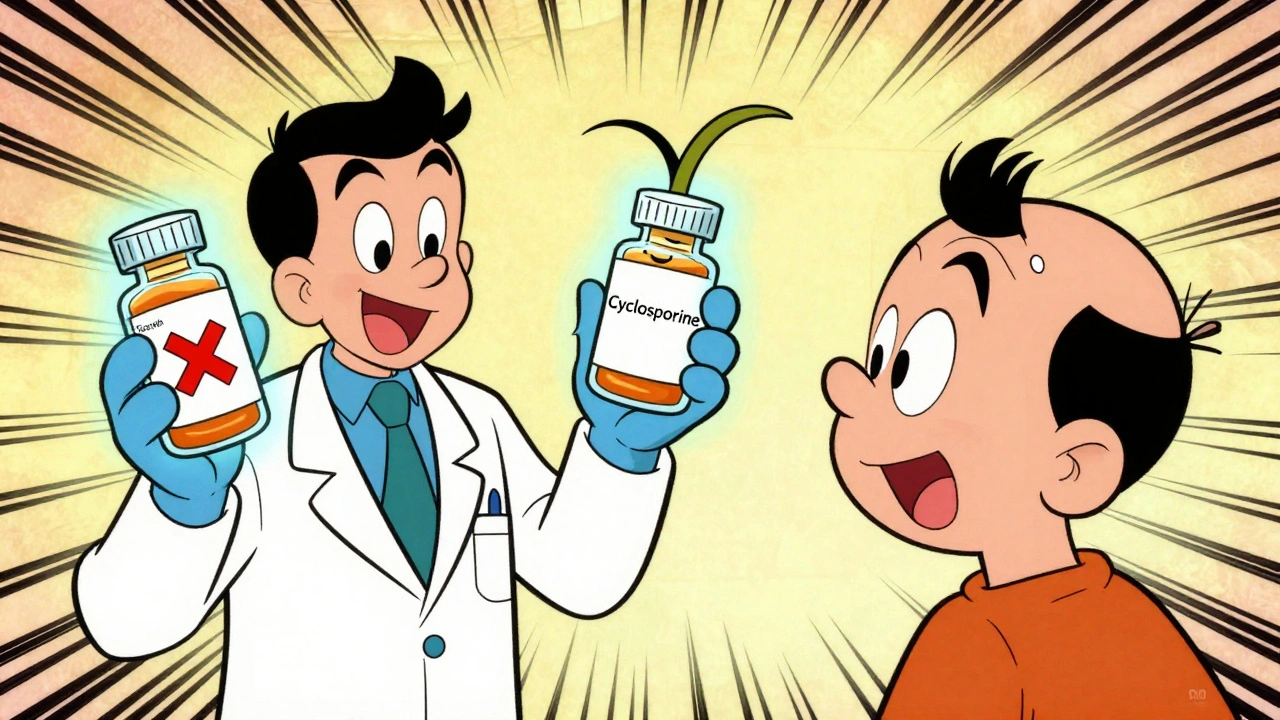
Here’s the twist: cyclosporine, another immunosuppressant, does the opposite. It can actually cause unwanted hair growth in 20-30% of users. Both drugs work by blocking the immune system, but they affect different pathways in hair follicles. Tacrolimus seems to interfere with Wnt signaling, which is essential for hair growth. Cyclosporine, oddly enough, activates it. That’s why switching from tacrolimus to cyclosporine has helped some patients regain their hair.
Which Medications Are Most Likely to Cause Hair Loss?
Not all immunosuppressants carry the same risk. Here’s a breakdown based on real-world data:
| Medication | Common Use | Reported Hair Loss Rate |
|---|---|---|
| Tacrolimus (Prograf) | Kidney, liver, heart transplants | 28.9% |
| Methotrexate | Rheumatoid arthritis, psoriasis | 3-7% |
| Leflunomide (Arava) | Rheumatoid arthritis | ~10% |
| Etanercept (Enbrel) | Autoimmune diseases (RA, psoriasis) | 4.4% |
| Azathioprine (Imuran) | Autoimmune disorders, transplant | 5-8% |
| Cyclosporine (Neoral) | Transplant, psoriasis | 0% (may cause hair growth) |
Women are more likely to notice hair loss than men-not because the drug affects them differently, but because they tend to have thinner hair to begin with. A 2003 study found an 11:2 female-to-male ratio among those affected by tacrolimus. If you already have a family history of thinning hair or an autoimmune condition like lupus that causes hair loss, your risk goes up by 40%.
How Long Does It Take for Hair Loss to Start?
Most people don’t notice changes right away. Hair loss from immunosuppressants usually shows up between 3 and 6 months after starting the drug. But in some cases, it can take over a year. One study found the average delay was 422 days-nearly 14 months. That’s long enough for patients to forget the medication might be the cause.
When you start losing more hair than usual-especially when brushing, washing, or pulling it into a ponytail-it’s worth asking your doctor. A sudden increase in shedding, not just thinning, is a red flag. Your dermatologist can tell if it’s drug-induced or something else, like a flare-up of your underlying disease. Some patients mistake disease activity for side effects. That’s why a proper evaluation matters.
What Can You Do About It?
The good news? Most of this hair loss is reversible. You don’t have to live with it. But you also can’t stop your medication on your own. Skipping doses to save your hair could lead to organ rejection or a dangerous disease flare. The Organ Procurement and Transplantation Network found a 15.2% spike in rejection cases among people who lowered their doses without medical supervision.
Here’s what actually works, based on clinical evidence and patient reports:
- Use minoxidil (Rogaine) 5% - This is the most common and best-supported treatment. Apply it to your scalp twice daily. Results take time-most people see improvement after 4 to 6 months. In one study, 68% of users reported some benefit, and 32% regained most of their hair. One Reddit user, after losing 40% of their hair on tacrolimus, regained 70% after 6 months of using minoxidil foam.
- Consider switching medications - If your hair loss is severe and you’re on tacrolimus, talk to your transplant team about switching to cyclosporine. It’s not a simple swap-dosing and side effects differ-but it’s been successful in cases where minoxidil didn’t help.
- Try low-level laser therapy (LLLT) - Devices like the Capillus82 have been shown to increase hair density by over 22% after 6 months of regular use. It’s not a miracle, but for some, it’s a helpful boost.
- Supplement with biotin and zinc - While the evidence isn’t strong, many patients report feeling better when they take 10,000 mcg of biotin and 50 mg of zinc daily. These support general hair health and may help if you’re deficient.
Don’t waste money on unproven treatments like scalp massages, essential oils, or expensive shampoos labeled "for thinning hair." They rarely move the needle. Stick to what’s been tested.
The Emotional Toll Is Real
One patient on a transplant forum said, "I cried every time I washed my hair." That’s not an exaggeration. Hair loss doesn’t just change how you look-it changes how you feel about yourself. A Healthline survey found 78% of people on immunosuppressants said hair loss affected their social life. Forty-four percent admitted they thought about cutting their dose to stop it.
Dr. Rodney Sinclair from the University of Melbourne says 22% of patients in one study considered stopping their life-saving drugs because of hair loss. That’s terrifying. But here’s the key: your doctors need to know this is happening. Many transplant centers didn’t even talk about hair loss until recently. Now, 37% of centers include it in pre-transplant counseling-up from just 12% in 2018.
For women, this can feel especially isolating. Society already puts pressure on how women look. Add a chronic illness and a medication that strips your hair, and it’s easy to feel broken. You’re not alone. Thousands of others are going through the same thing.

What’s New in Treatment?
Research is moving fast. In 2023, a clinical trial started testing topical JAK inhibitors-drugs already used for alopecia areata-for immunosuppressant-induced hair loss. Early results are promising. The FDA also gave breakthrough status to a scalp-cooling device adapted for transplant patients. It’s the same tech used by cancer patients to keep their hair during chemo. In early tests, it reduced hair loss severity by 65%.
Even more exciting: scientists have found genetic markers that predict who’s likely to lose hair on tacrolimus. If you carry certain variants of the WNT10A gene, you’re at higher risk. In the future, doctors might test your DNA before prescribing immunosuppressants-and choose a drug that won’t trigger hair loss in the first place.
What to Do Next
If you’re on an immunosuppressant and noticing hair loss:
- Don’t panic. It’s common and usually temporary.
- Don’t stop your medication. Talk to your doctor first.
- See a dermatologist who specializes in hair disorders. They know how to tell if it’s the drug or your disease.
- Start minoxidil 5% twice daily. Give it 6 months.
- Ask if switching to cyclosporine is an option.
- Consider LLLT or supplements like biotin and zinc if you’re open to them.
Remember: you’re taking these drugs to live. Hair loss is a side effect, not a failure. With the right steps, you can keep your health-and your hair.
Can immunosuppressants cause permanent hair loss?
No, hair loss from immunosuppressants is almost always temporary. Once the drug is stopped or switched, and with proper treatment like minoxidil, hair typically regrows within 6 to 12 months. The follicles aren’t destroyed-they’re just stuck in resting mode. Permanent loss is extremely rare unless there’s an underlying scarring condition.
Does minoxidil work for hair loss caused by tacrolimus?
Yes, minoxidil works well for tacrolimus-induced hair loss. In one study, it was successful in all but one patient. Most see noticeable regrowth after 4 to 6 months of consistent use. The foam form is often preferred because it’s less greasy and easier to apply daily.
Can I switch from tacrolimus to cyclosporine to stop hair loss?
Yes, switching from tacrolimus to cyclosporine has resolved hair loss in patients who didn’t respond to minoxidil. Cyclosporine doesn’t cause hair loss-it can even promote growth. But the switch must be done carefully under medical supervision because dosing and side effect profiles differ. Your transplant team will monitor your kidney function and blood pressure closely.
Is hair loss from immunosuppressants more common in women?
Yes, significantly. Studies show women are much more likely to experience hair loss from drugs like tacrolimus than men. One study found an 11:2 female-to-male ratio. This may be due to hormonal differences, thinner baseline hair density, or how female hair follicles respond to immune disruption. It’s not just about the drug-it’s about how your body interacts with it.
Should I take biotin or zinc for medication-related hair loss?
Biotin and zinc won’t reverse hair loss on their own, but they can support overall hair health, especially if you’re deficient. Many people on immunosuppressants have lower nutrient levels due to medication effects or dietary changes. Taking 10,000 mcg of biotin and 50 mg of zinc daily is safe for most and may help improve texture and growth speed. It’s not a cure, but it’s a low-risk supportive step.
When should I see a dermatologist about hair loss?
See a dermatologist specializing in hair disorders if you’re losing more than 100 hairs a day for over 3 weeks, or if you notice thinning patches, scalp redness, or breakage. Don’t wait until you’re losing clumps. Early evaluation helps rule out other causes like lupus flares or fungal infections and gets you on the right treatment faster.

Francine Phillips
December 2, 2025 AT 08:33Been on tacrolimus for 3 years and my hair is still thin as hell. Minoxidil did nothing for me. Just accepted it as part of the package. Don't even brush it anymore.
Katherine Gianelli
December 3, 2025 AT 04:11I felt so alone when I started losing my hair after my transplant. Then I found this thread. You're not broken. You're surviving. And that's more than enough. Try the foam minoxidil-it’s less messy and way easier to stick with. You got this 💪
sagar bhute
December 4, 2025 AT 00:15This whole post is a waste of time. If you're taking immunosuppressants you're already playing Russian roulette with your life. Hair loss is the least of your problems. Stop whining and focus on staying alive. Also cyclosporine causes hypertension and kidney damage-don't be a dumbass and switch without data.
Cindy Lopez
December 4, 2025 AT 14:53The data cited in this article is mostly from small, uncontrolled studies. The 28.9% hair loss rate for tacrolimus is not statistically significant across diverse populations. Also, 'biotin and zinc' are not evidence-based interventions for drug-induced telogen effluvium. Please cite peer-reviewed sources.
Vincent Soldja
December 4, 2025 AT 23:15While the article provides a reasonable overview, the emotional framing is excessive. Hair loss is a common side effect. The medical community has documented this for decades. The focus should remain on clinical outcomes, not subjective distress.
Makenzie Keely
December 5, 2025 AT 05:29PLEASE PLEASE PLEASE if you're reading this and you're losing your hair-don't suffer in silence!! Talk to your doctor!! I was terrified, I thought I was failing at being a transplant survivor… then I started minoxidil and LLLT-and now, 10 months later, my hair is back to 80%! It’s not magic, it’s science-and you deserve to feel like yourself again!! 💇♀️💖
Joykrishna Banerjee
December 7, 2025 AT 02:05Of course minoxidil 'works'-it's a vasodilator, not a cure. And cyclosporine? Please. It's nephrotoxic and has a 1:3 chance of causing gingival hyperplasia. You're trading one cosmetic nuisance for a lifetime of dental visits. Also, WNT10A variants are not clinically validated biomarkers. This is pseudoscience dressed as hope.
James Kerr
December 7, 2025 AT 11:22Man, I lost my hair on tacrolimus too. Didn't do anything at first. Then I just started wearing beanies. Now I rock them. People think I'm cool. Hair's overrated anyway. Stay alive, stay chill.
shalini vaishnav
December 7, 2025 AT 21:14In India, we don't even have access to minoxidil or LLLT. People here just accept it. You Americans think everything can be fixed with a pill or a device. We're lucky if we get the immunosuppressant at all. Stop complaining about hair and be grateful you're alive.
vinoth kumar
December 8, 2025 AT 17:59Hey I'm on tacrolimus too and I tried biotin + zinc for 3 months. My hair stopped falling out after 6 weeks. Not a cure but it helped me feel better. Also, I started using a silk pillowcase-no more hair on my pillow. Small wins, right?
bobby chandra
December 10, 2025 AT 12:45Let me tell you something real-this isn't about hair. It's about identity. You take a drug to live, but you start feeling like a ghost in your own skin. I cried in the mirror every morning for 8 months. Then I got a wig. Not because I wanted to hide-but because I wanted to feel like me again. And guess what? I'm still alive. Still fighting. And my hair? It's coming back. Slow. But it's coming.
Archie singh
December 12, 2025 AT 11:58Don't believe the hype. Minoxidil is a placebo with side effects. LLLT? A scam. The only reason people 'regain' hair is because the drug was tapered or their body adapted. Hair loss from immunosuppressants is temporary by design-your follicles aren't dead, they're just waiting. Stop wasting money.
Gene Linetsky
December 13, 2025 AT 13:54Ever wonder why only women report this? Coincidence? Or did the pharma companies design tacrolimus knowing it would affect women more? I've got a friend who lost her hair and then her job. Her boss said she looked 'unprofessional.' Who benefits from women feeling ashamed of their bodies while taking life-saving drugs? Just saying.
Ignacio Pacheco
December 14, 2025 AT 06:24So… you're telling me cyclosporine causes hair growth… but you can't just switch because of kidney risks? So the drug that makes you look normal also kills your kidneys? And the one that spares your kidneys makes you look like you're dying? Brilliant. So the only solution is… to suffer silently while applying foam?