

Imagine spending fifteen minutes by a sunny office window and waking up two days later with a vivid, butterfly-shaped rash across your face. For many, this sounds like an extreme allergic reaction, but for people living with cutaneous lupus erythematosus, it is a daily reality. This isn't just a simple sunburn; it is a complex immune response where the sun literally triggers the body to attack its own skin cells.
If you've noticed that your skin reacts violently to the sun, or if your doctor mentioned "photosensitivity," you aren't alone. About 50% to 75% of people with lupus experience this. The tricky part is that the reaction doesn't always happen instantly. You might feel fine on Saturday, only to have a flare-up hit on Monday. Understanding why this happens and how to block those triggers is the most effective way to stop these flares before they start.
| Subtype | Common Appearance | Sun Reaction Pattern |
|---|---|---|
| Acute (ACLE) | Malar "butterfly" rash on cheeks/nose | Rapid onset after UV exposure; high systemic flare risk |
| Subacute (SCLE) | Ring-shaped or scaly patches | Commonly triggered by sun in exposed areas (chest, arms) |
| Chronic (CCLE) | Thick, scarred, coin-shaped disks | Sun exposure makes existing lesions worse/more permanent |
Why Your Skin Reacts: The Science of Photosensitivity
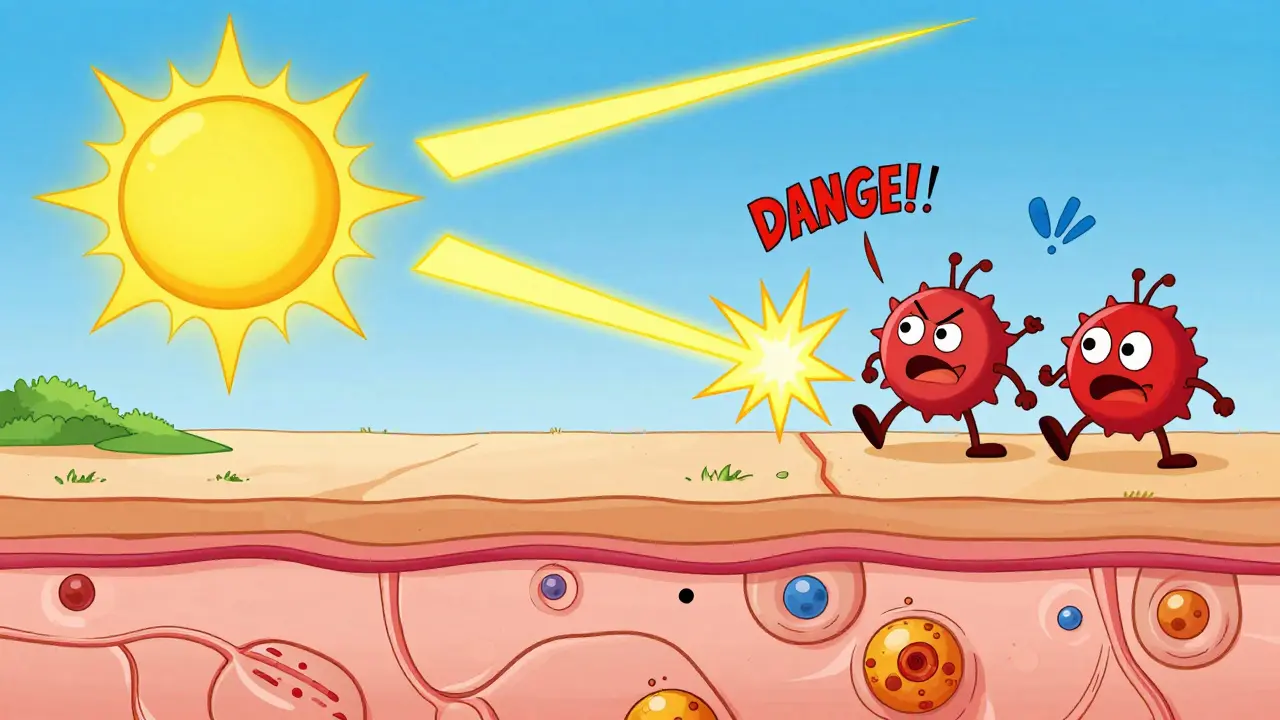
To manage the skin, we have to understand what's happening under the surface. Photosensitivity is an abnormal reaction of the skin to ultraviolet (UV) radiation, where light triggers an inflammatory immune response. In a healthy person, a sunburn is mostly about surface damage. In someone with lupus, UV rays cause a deeper biological chain reaction.
When UVB radiation is the short-wavelength ultraviolet light that primarily causes sunburns hits the skin of a lupus patient, it causes DNA breaks in skin cells (keratinocytes) at a rate over twice as fast as in people without the condition. This cell death sends a "danger signal" to the immune system. Specifically, it spikes the production of interferon-kappa (IFN-κ), a signaling protein that can increase by up to 600% after sun exposure. This essentially tells your immune system to attack the skin, leading to the red, inflamed lesions we see on the surface.
It isn't just the beach that's the enemy. UVA radiation, which has longer wavelengths, can penetrate glass and clouds. This is why you can have a flare-up while sitting in a car or near a window. Even indoor fluorescent lights, which emit small amounts of UV, can be enough to trigger a reaction for some people.
Identifying Your Specific Type of Rash
Not every lupus rash looks the same. Identifying which version you have helps in tailoring the treatment. The most famous is the malar rash, which affects about 85% of those with acute cutaneous lupus. It creates a distinct butterfly pattern across the bridge of the nose and cheeks. These are often "hot" rashes that feel inflamed and appear shortly after sun exposure.
Then there is Subacute Cutaneous Lupus (SCLE). These look more like rings or scaly patches and usually show up in areas that get the most sun, like the "V" of the chest or the backs of the arms. About 92% of SCLE patients report a direct link between sun exposure and new lesions.
Chronic cases, often called Discoid Lupus, are different. These aren't usually "flares" in the traditional sense, but rather permanent, scarring lesions. Here, the sun doesn't necessarily create a new rash, but it makes the existing ones much deeper and more likely to leave a permanent scar. If you notice your skin thickening or losing pigment in a specific spot, that's a sign of chronic involvement.
Practical Strategies to Block UV Triggers
You can't avoid the sun entirely, but you can change how you interact with it. Clinical data suggests that rigorous photoprotection can prevent up to 70% of cutaneous flares. Here is how to actually do it without feeling like you're living in a bubble.
The Sunscreen Protocol
Not all sunscreens are created equal. For lupus, you need a broad-spectrum SPF 50+. Look for "physical" or "mineral" blockers rather than chemical ones. Ingredients like zinc oxide and titanium dioxide sit on top of the skin and reflect UV rays away, which is generally better tolerated by sensitive lupus skin. The key is reapplication every two hours; if you apply it at 8 AM and go for a walk at noon, you're essentially unprotected.
Physical Barriers and Clothing
Sunscreen is the second line of defense; clothing is the first. Look for clothes with a UPF rating, which is a textile industry standard for measuring how much UV radiation a fabric allows to reach the skin . A UPF 50+ shirt blocks about 98% of UV rays. Wide-brimmed hats are non-negotiable for face protection, as the malar rash is so closely tied to direct facial exposure.
Managing Your Indoor Environment
If you work in an office with old fluorescent tubes, you might be getting hit by UV rays all day. Switching to LED lighting can reduce this exposure by over 90%. If you can't change the bulbs, consider UV-blocking window films. These clear films can reduce UVA transmission by nearly 99.9%, meaning you can sit by the window without worrying about a delayed flare.
Medical Treatments for Skin-Targeted Lupus
When sunscreen and hats aren't enough, it's time for medical intervention. Treatment usually starts with topical options to calm the local inflammation before moving to systemic drugs.
Topical corticosteroids are the first line of defense to reduce swelling and redness. However, long-term use can thin the skin, so doctors often rotate these with calcineurin inhibitors (like tacrolimus), which dampen the immune response without damaging the skin's structure. For those with severe sensitivity, Hydroxychloroquine is often prescribed. It's widely considered the "gold standard" for lupus because it not only protects the skin but also reduces the risk of internal organ flares.
The frontier of treatment is moving toward biologics. Anifrolumab, an FDA-approved monoclonal antibody, specifically targets the interferon receptor. Since we know interferon is the main driver of the sun-induced flare, blocking it at the source has shown significant success in clearing skin lesions. Newer JAK inhibitors are also being studied to block these same inflammatory pathways, potentially offering a pill-based alternative to injections.

The Hidden Impact: Beyond the Rash
Photosensitivity isn't just a skin problem. For about 63% of photosensitive lupus patients, a sun-triggered skin rash is followed by systemic symptoms, such as joint pain, extreme fatigue, or "brain fog." This happens because the UV damage triggers a systemic release of inflammatory cytokines into the bloodstream.
There is also a psychological toll. Many people feel isolated when they have to wear long sleeves and hats in the middle of summer, or when they can't join a beach trip. Furthermore, many patients report a frustrating "diagnostic gap," where primary care doctors mistake their lupus rash for a simple allergy or eczema, delaying critical treatment for months.
Does the reaction happen immediately after sun exposure?
Not usually. While some redness may appear quickly, true lupus photosensitivity typically manifests 24 to 72 hours after exposure. The rash can then last anywhere from 3 to 21 days. If a reaction persists beyond three weeks, it's a strong clinical indicator of lupus-related photosensitivity rather than a common sun allergy.
Can fluorescent lights actually trigger a lupus flare?
Yes. Compact fluorescent lamps (CFLs) and some older fluorescent tubes emit small amounts of ultraviolet radiation. While much weaker than the sun, this can be enough to trigger a reaction in highly sensitive individuals. Switching to LED lighting is the most effective way to mitigate this risk.
Is there a difference between a lupus rash and a normal sunburn?
Yes. A normal sunburn is generally limited to the area that was exposed and fades as the skin peels. A lupus rash is an autoimmune reaction. It often appears in specific patterns (like the butterfly shape), may be accompanied by joint pain or fever, and is caused by the immune system attacking healthy skin cells rather than just surface burns.
Which sunscreen ingredients are best for cutaneous lupus?
Mineral-based sunscreens containing zinc oxide or titanium dioxide are generally recommended. These are physical blockers that reflect UV rays away from the skin. They are typically less irritating than chemical sunscreens, which absorb UV rays and can sometimes cause further irritation in sensitive lupus skin.
Can medication completely cure photosensitivity?
There is currently no cure for lupus, but photosensitivity can be managed effectively. Medications like hydroxychloroquine and new biologics like anifrolumab can significantly reduce the skin's reactivity to UV light, though strict photoprotection (sunscreen and clothing) remains a necessary lifelong habit.
Next Steps for Management
If you suspect you have cutaneous lupus, your first move should be a skin biopsy. Because lupus rashes can look like other conditions (such as PMLE or dermatomyositis), a biopsy is the only way to confirm the specific histology of the inflammation. Once confirmed, work with a rheumatologist and a dermatologist together; treating the skin without treating the systemic immune response is only half the battle.
For those already diagnosed, start a "trigger diary." Note the time of exposure, the type of light (sun, window, fluorescent), and when the rash appeared. This data is invaluable for your doctor to determine if you are reacting to UVA, UVB, or both, which allows them to fine-tune your medication and protection strategy.

Mark Zhang
April 5, 2026 AT 23:20This is a really helpful breakdown of the different subtypes. I've seen so many people struggle with the delayed reaction part and feel like they're losing their minds when a rash appears days later.
Rob Newton
April 7, 2026 AT 16:06Mineral sunscreen is overrated.
Brian Shiroma
April 8, 2026 AT 01:40Oh sure, because telling people to just buy a new lighting system for their entire office is totally practical and not a complete fantasy for anyone who doesn't own the building.
Divine Manna
April 9, 2026 AT 03:27The preoccupation with the physical manifestation of the disease often obscures the metaphysical reality that our biology is merely a reflection of internal disharmony. One must realize that the skin is not merely a barrier, but a canvas upon which the soul's distress is painted with systemic precision. To treat the rash without addressing the existential void is a futile exercise in vanity.
simran kaur
April 9, 2026 AT 05:15Funny how they mention LED lights but don't talk about how these "medical treatments" are actually just tools for the pharmaceutical companies to track our biological responses in real-time. They want us dependent on biologics so we're easier to monitor via the frequencies emitted by these new LED systems they're so keen on us installing. It's all part of the same grid, obviously.
The Charlotte Moms Blog
April 9, 2026 AT 21:54The lack of emphasis on holistic gut health here is... staggering!!! You cannot possibly manage a systemic autoimmune flare... without addressing the microbiome first!!! This is exactly why so many people stay sick!!!
Ace Kalagui
April 11, 2026 AT 09:20I really appreciate how this guide simplifies the complex science behind interferon-kappa because when I was first helping my community members navigate these diagnoses, we found that the lack of clear, accessible information created so much unnecessary anxiety and confusion for everyone involved in the care process. It is so important to have these resources that bridge the gap between high-level medical jargon and the actual daily experience of living with the condition, and I truly believe that empowering patients with this kind of knowledge is the first step toward a more inclusive and supportive healthcare environment for all of us.
Joey Petelle
April 12, 2026 AT 15:40Imagine thinking a fancy hat is the peak of medical innovation lol. This whole "gold standard" hydroxychloroquine vibe is just a fancy way of saying "hope this works because we have no clue." Pure comedy.
Joseph Rutakangwa
April 13, 2026 AT 07:28zinc is the way to go
Will Baker
April 13, 2026 AT 22:08Wait, so you're telling me that sitting in a car can literally make your skin attack itself? That is just delightful. I love how this disease just finds new and creative ways to make life absolutely miserable while everyone else is just enjoying a nice drive.
Sakshi Mahant
April 14, 2026 AT 11:38In many of our cultures, we emphasize gentle care and natural barriers. It is very interesting to see the clinical side of this, and I believe combining these medical insights with traditional mindfulness can help the psychological toll mentioned.
Jenna Carpenter
April 14, 2026 AT 13:01I tried the mineral stuff and it just left a white cast... totaly ruined my makeup. I dont see why we cant just use natural oils instead of these chemicle blockers that probably cause more problems anyway.
Dee McDonald
April 14, 2026 AT 15:28Get those UV films on your windows NOW! Don't wait for the next flare to hit your system because once the cytokine storm starts, you're just playing catch-up! Be proactive or be miserable!