

Most people don’t think about earwax until it starts causing problems-muffled hearing, a feeling of fullness, or even dizziness. Earwax, or cerumen, is actually a natural and necessary part of ear health. It traps dust, protects the ear canal from infection, and keeps the skin moisturized. But sometimes, it builds up too much. When that happens, it can block the ear canal and lead to discomfort or hearing loss. This is called cerumen impaction, and it affects about 6% of adults and up to 30% of older adults. The good news? You can often fix it at home with the right tools and techniques.
What Are Cerumenolytics?
Cerumenolytics are ear drops designed to soften hardened earwax so it can drain out naturally or be gently removed with irrigation. These aren’t new. Doctors have been using them since the early 1900s. But in the 1980s, the FDA approved over-the-counter formulas like carbamide peroxide, making them widely available. Today, they’re the first-line treatment recommended by the Mayo Clinic, the American Academy of Family Physicians, and the American Academy of Otolaryngology before any professional procedure.
They work by breaking down the wax’s sticky, waxy structure. Some dissolve it chemically. Others lubricate it so it slides out more easily. The key is patience-these aren’t instant fixes. You usually need to use them for several days before the wax loosens enough to come out.
Common Types of Cerumenolytics and How They Work
Not all earwax softeners are the same. Each type has a different mechanism, and the best one for you depends on your earwax type and sensitivity. Here are the most common options:
- Carbamide peroxide (Debrox, Murine): This is the most popular OTC option. It breaks down into hydrogen peroxide and urea when it hits moisture. The bubbling you feel? That’s the peroxide loosening the wax. Use 5-10 drops twice a day for up to 7 days. Studies show it works in about 65% of cases when used correctly.
- Hydrogen peroxide (3%): Diluted with equal parts sterile water, this is a budget-friendly alternative. It’s great for wet, sticky wax because of its effervescent action. But it can sting if you have sensitive skin or a minor scratch in the ear canal. Never use full-strength peroxide-it’s too harsh.
- Mineral oil, baby oil, or olive oil: These are gentle, lubricating options. They don’t fizz or bubble. Instead, they soak into the wax over time, making it slippery. Use 3-6 drops once a day for 3-4 nights. They’re ideal for dry, flaky wax and safe for long-term use.
- Baking soda solution: Mix ¼ teaspoon (1.25 mL) of baking soda with 2 teaspoons (10 mL) of sterile water. This creates a 15% solution that gently breaks down wax. Apply twice daily for 4 days. It’s especially helpful for thick, stubborn buildup.
- Docusate sodium (Colace): This is an off-label use of a stool softener. Some ENTs recommend 1 mL placed in the ear 15 minutes before irrigation. It’s not FDA-approved for ears, but research shows it improves irrigation success better than some traditional drops.
How to Use Cerumenolytics Correctly
Using these drops wrong is the #1 reason people think they don’t work. Here’s the right way:
- Wash your hands. Use only sterile or distilled water for mixing solutions.
- Warm the bottle by holding it in your hand for a minute. Cold drops can cause dizziness.
- Lie on your side with the affected ear facing up. Don’t just tilt your head-fully lie down.
- Put in the number of drops recommended (usually 5-10).
- Stay still for 5-10 minutes. This lets the solution soak deep into the wax. Many people skip this step and wonder why it didn’t work.
- Turn your head to the side to let the excess drain out. Wipe away what comes out with a clean cloth.
- Repeat as directed-usually once or twice daily for 3 to 7 days.
Seattle Children’s Hospital found that people who stayed lying down for 10 minutes after applying drops had a 40% higher success rate than those who stood up right away.

What Works Best? A Quick Comparison
| Product Type | Active Ingredient | Typical Use Duration | Effectiveness | Best For |
|---|---|---|---|---|
| Debrox / Murine | 6.5% carbamide peroxide | 5-7 days | 65% | Sticky, moist wax |
| Hydrogen Peroxide (diluted) | 3% H₂O₂ + equal water | 2-3 days | 60% | Wet, impacted wax |
| Mineral/Olive Oil | Plant oils | 3-4 days | 58% | Dry, hardened wax |
| Baking Soda Solution | 15% NaHCO₃ | 4 days | 62% | Thick, stubborn buildup |
| Docusate Sodium | Colace (off-label) | 1-2 days (pre-irrigation) | 70% | Before professional removal |
Research from the Journal of Laryngology & Otology in 2017 found that carbamide peroxide outperformed oils in most cases. But a 2023 University of Washington study showed that combining mineral oil for 3 nights followed by a single hydrogen peroxide rinse cleared 89% of cases-better than either alone.
When NOT to Use Cerumenolytics
These drops are safe for most people-but not everyone. You should avoid them if you have:
- An active ear infection (pain, drainage, fever)
- A perforated eardrum (you’ll know if you’ve had surgery or trauma)
- Recent ear surgery (within the last 6-8 weeks)
- Ear tubes (tympanostomy tubes)
GoodRx’s 2023 analysis found that 8% of failed home treatments were due to people using drops despite having an infection. This can make things worse. If you’re unsure, skip the drops and see a doctor.
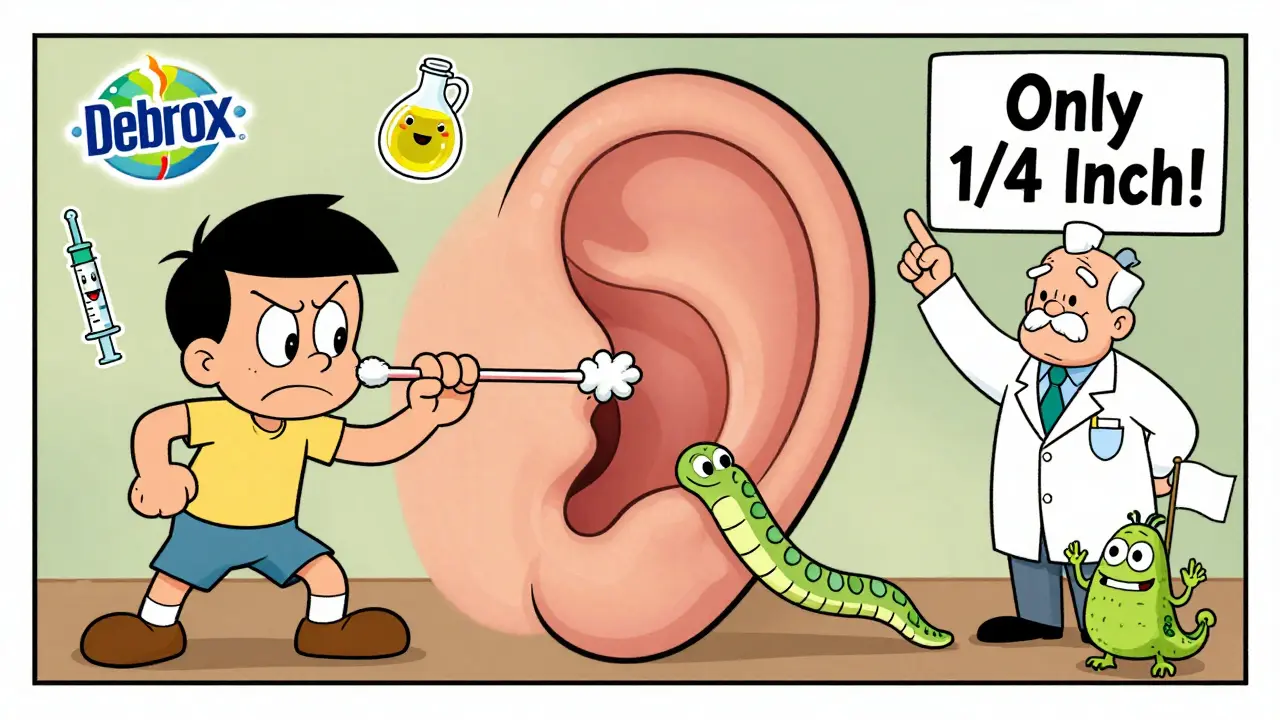
Also, never stick anything into your ear canal-not cotton swabs, not bobby pins, not your finger. The FDA says you should only insert objects up to ¼ inch into the ear. Most people go way past that, which pushes wax deeper and scrapes the delicate skin, leading to infections or even hearing damage. In fact, 65% of ear injuries treated in ERs come from cotton swab use.
What to Expect After Treatment
After using cerumenolytics for several days, you might notice:
- A feeling of fullness easing up
- Improved hearing
- Waxy debris in the outer ear
- A slight bubbling or tingling sensation (normal with peroxide)
If after 7 days you still feel blocked, or if your hearing hasn’t improved, don’t try to force it. Go to a doctor. About 25% of earwax blockages are too hard to remove at home. That’s when professional irrigation or suctioning is needed.
Some people report success with irrigation after softening. Use warm (not hot) water and a bulb syringe. Never use tap water-it can carry bacteria. Use distilled or boiled water cooled to body temperature. Mayo Clinic warns that using non-sterile water increases the risk of serious ear infections.
Why Home Treatment Matters
Cerumen impaction isn’t just annoying-it’s costly. In the U.S., it leads to 12 million doctor visits every year, costing the healthcare system around $116 million. Most of these visits could be avoided with proper home care.
The market for cerumenolytics is growing fast. It’s now a $287 million segment of the ear care industry, with Debrox holding 38% of the market and Murine at 29%. New products are emerging-like Debrox Max, which uses a time-release formula to stay in the ear longer. In January 2023, the FDA approved a new combination drop (hydrogen peroxide 2.5% + glycerin 86%), the first new formula in 15 years.
And it’s not just older adults. With more people using in-ear headphones daily, earwax buildup is rising. ENT Care Centers report a 22% year-over-year increase in impaction cases since 2019. Softening earwax at home isn’t just convenient-it’s becoming essential.
Real User Experiences
Reddit threads and product reviews tell the real story. On r/audiology, users shared:
- u/AudiologyTech: "Five nights of olive oil before irrigation removed 90% of my impaction. No pain, no fuss."
- u/EarPainSurvivor: "I tried hydrogen peroxide straight from the bottle. Burning for 20 minutes. Never again."
- u/EarCarePro: "Debrox worked great-but only because I left it in for 10 minutes. I used to just drop it and stand up. Total waste."
Amazon reviews show that 78% of users who followed instructions reported success. But 34% of negative reviews blamed not leaving the drops in long enough. The lesson? Patience and technique matter more than the product.
Final Tips
- Don’t rush. Most solutions need 3-7 days.
- Stay lying down for 5-10 minutes after applying drops.
- Use sterile water for mixing solutions.
- Never insert anything deeper than the outer third of your ear canal.
- Stop and see a doctor if you have pain, drainage, or no improvement after a week.
- Keep your ears dry after showering-moisture can lead to wax buildup.
Earwax isn’t dirt. It’s your body’s defense system. The goal isn’t to remove it all-it’s to keep it balanced. With the right cerumenolytic and proper technique, you can manage buildup safely, comfortably, and without a doctor’s visit.

Kal Lambert
March 20, 2026 AT 12:15Linda Olsson
March 20, 2026 AT 17:54Emily Hager
March 21, 2026 AT 09:45Melissa Starks
March 21, 2026 AT 22:37Also I didn't know docusate sodium was a thing. That's wild. I'm gonna try that next time. My earwax is like concrete now.
Ryan Voeltner
March 22, 2026 AT 11:31Lauren Volpi
March 23, 2026 AT 06:39Ayan Khan
March 24, 2026 AT 22:00It's not about what's new. It's about what works quietly, without force.
cara s
March 25, 2026 AT 00:06Melissa Stansbury
March 26, 2026 AT 23:17